South
Atlantic
Three weeks under jury rig. Seven hundred and forty miles to a volcanic island. Five of us and a cat.
By the time we sailed from Gibraltar in October 1986, three places had been home aboard Chricanto: Plymouth, Vilamoura on the Portuguese Algarve, and Gibraltar itself. From Vilamoura we'd worked the Iberian coast — up the Guadalquivir to Seville, round the corner of Spain to Gibraltar. My father walked into the Naval Chart Depot one warm, blustery afternoon to buy charts for the leg south — Gibraltar to Durban, down the Atlantic. On a whim he added Admiralty Chart 1769 to the pile: Islands and Anchorages in the South Atlantic. He had no intention of visiting any of those islands. As it turned out, the last position he plotted on the voyage would be on that particular chart.
The yacht was called Chricanto — Chris, Candice, Antony, the names of the three children mashed together. My parents weren't subtle. She was fifteen metres of ferrocement, twenty-seven tonnes, a Hartley Tahitian cutter. My father had built her in our front garden in Durban. When we'd tried to get her out of the garden we'd knocked over a gate pillar — she was a little too big.
The crew was five of us: my father, who had grown up in naval bases; my mother Margaret, who never panicked, ever; me, thirteen, the watch-stander-in-training; my sister Candice, nine; my brother Antony, seven; and our cat, Pusskins.
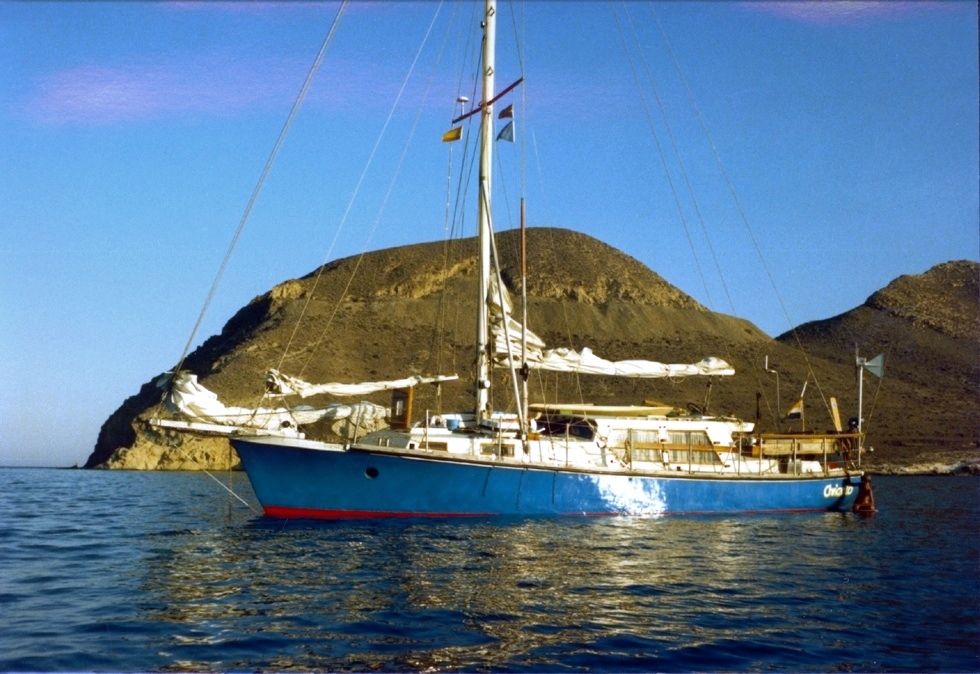
002 At anchor on the Mediterranean coast.
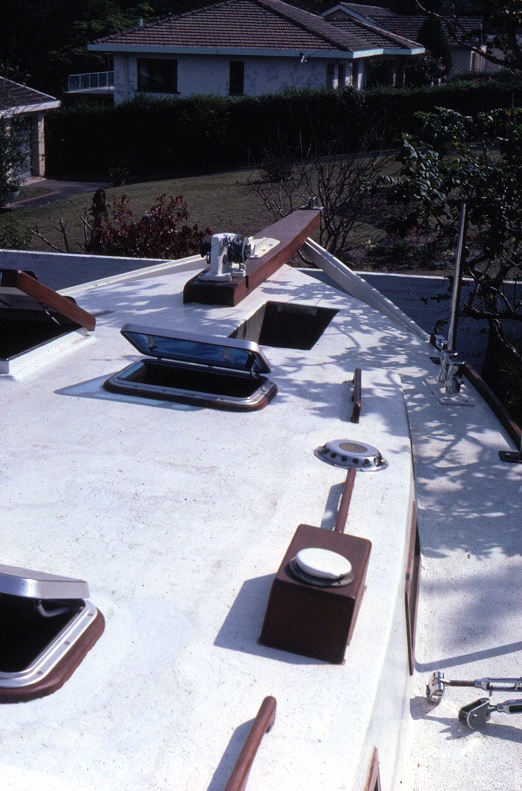
003 Under construction in the front garden, Durban.
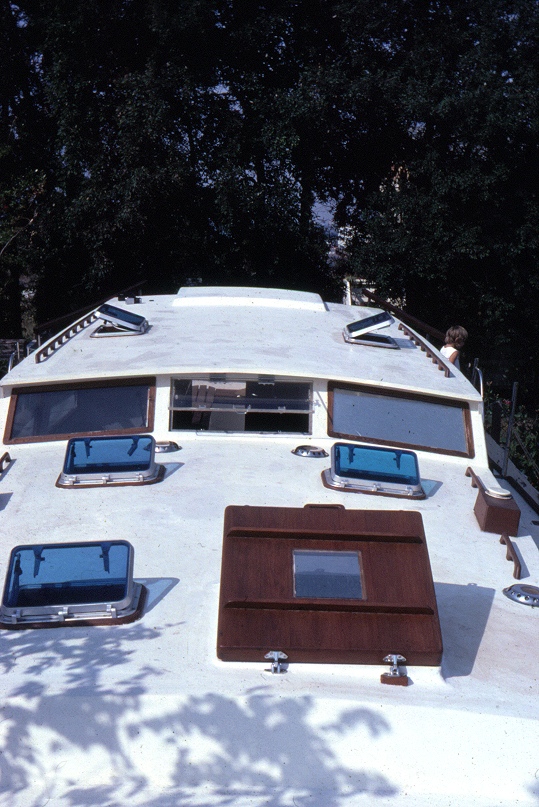
004 Cabin top, still being built.
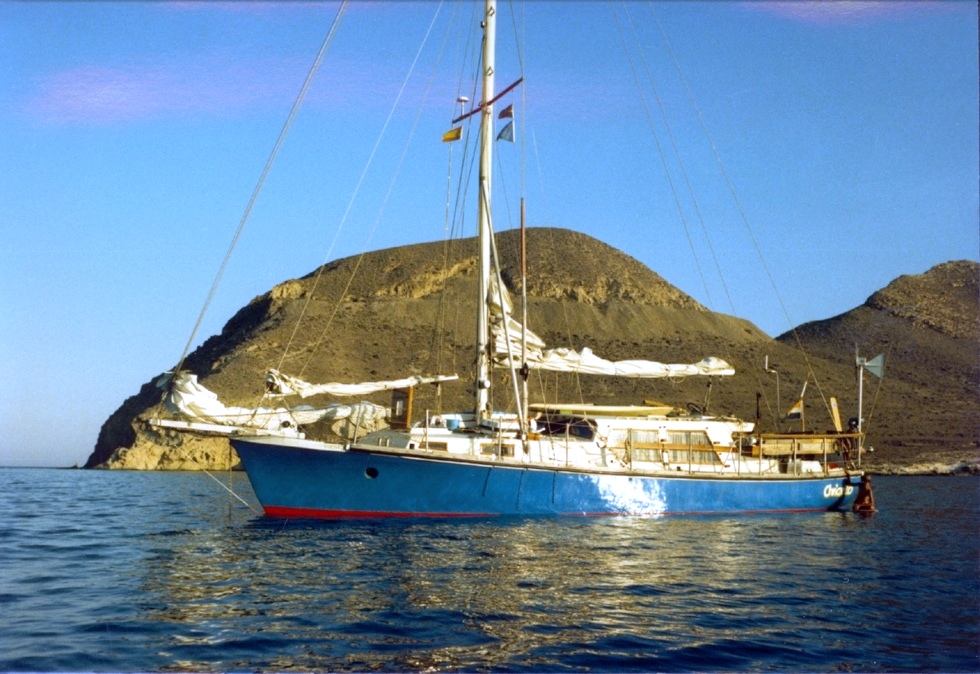
005 Heading back to Vilamoura from Faro.
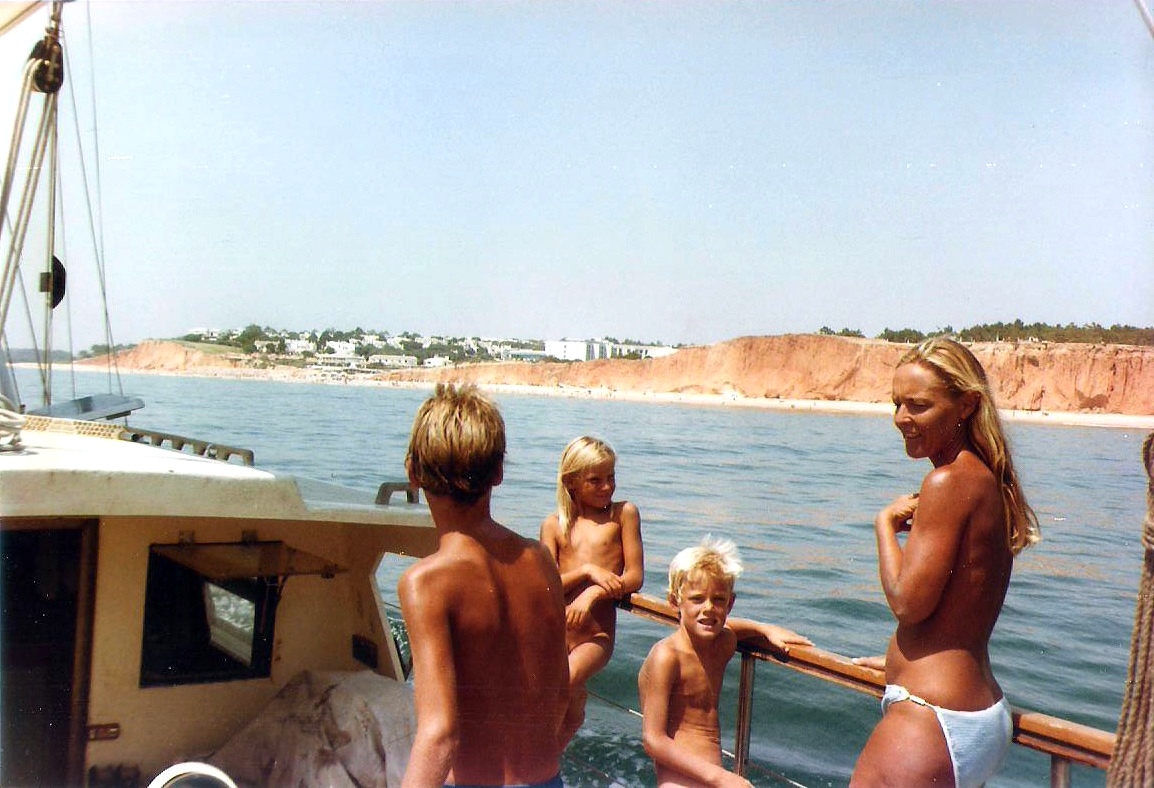
006 Trying a bit of surfing off Ilha Culatra.
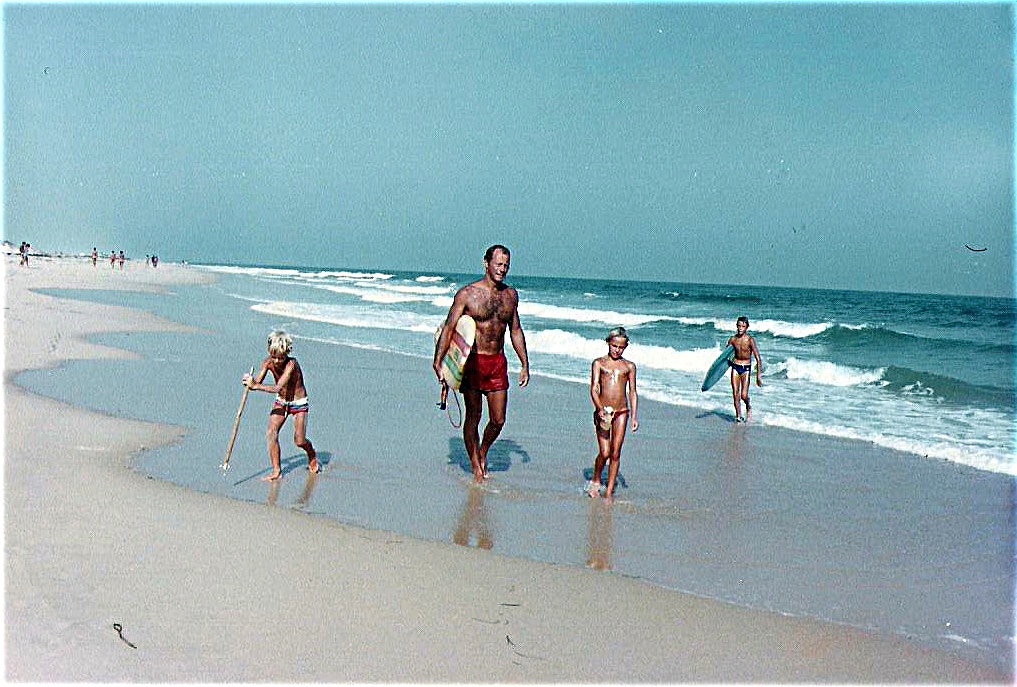
007 The upper Rio Guadiana.
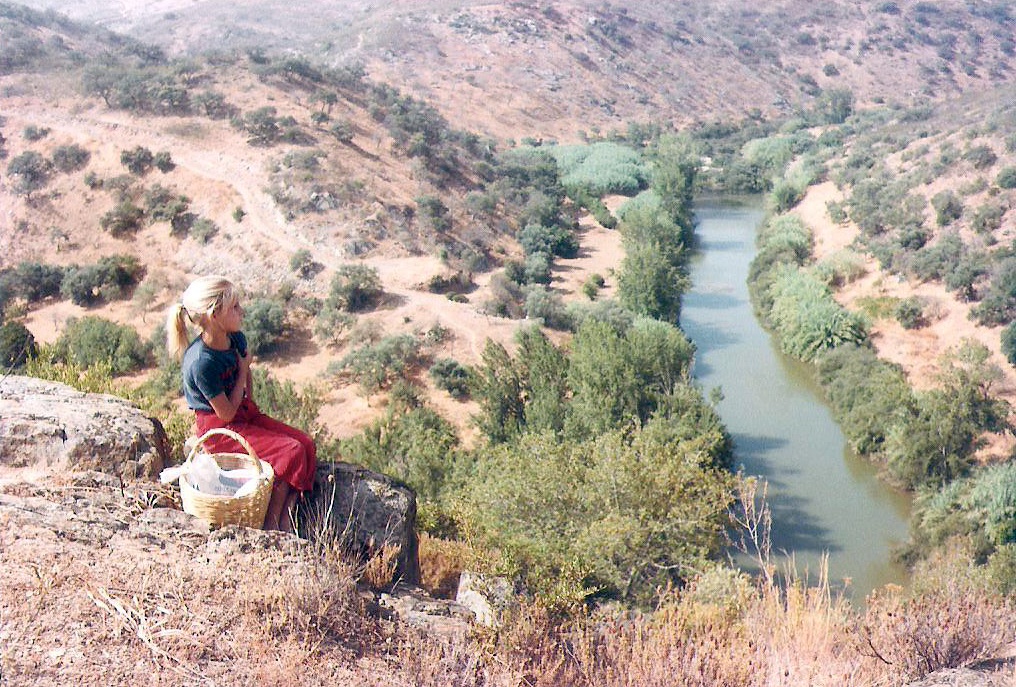
008 Above the Guadiana with a basket.
008b Approaching Málaga — we stopped for Italian visas we never used.
We sailed on 20 October into thick fog. The fog dissipated as the predicted Levanter came on. Within hours we'd shot clear of the Straits, settling into the slow long-ocean rhythm: twin headsails poled out wing-and-wing, mainsail reefed, the Atlantic opening up west of us.
A day out, my father asked me to stand my first solo watch — four hours of pitch dark, alone in the cockpit. He went down to sleep in my parents' bunk.
Some way in I started hearing clicks coming through the hull from below — dolphin-like, but with something more artificial about them. Then I saw a dark mass off to starboard. Then another off to port. They were warships, running blacked-out. A helicopter came in low from dead ahead, passed directly over us, turned, and flew back the way it had come. We had sailed into the middle of a fleet exercise. My father came up. We watched the dark masses slide past us in silence and disappear east. It turned out to be the easy part.
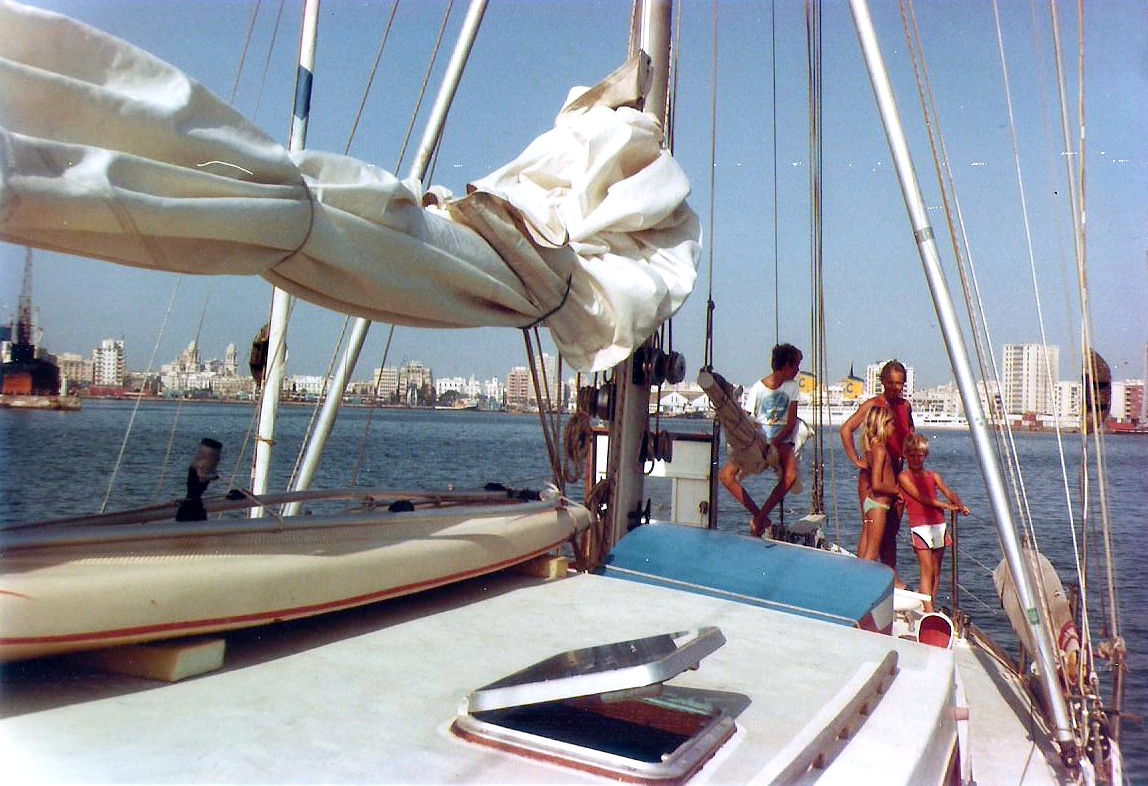
009 Marina Bay, Gibraltar.
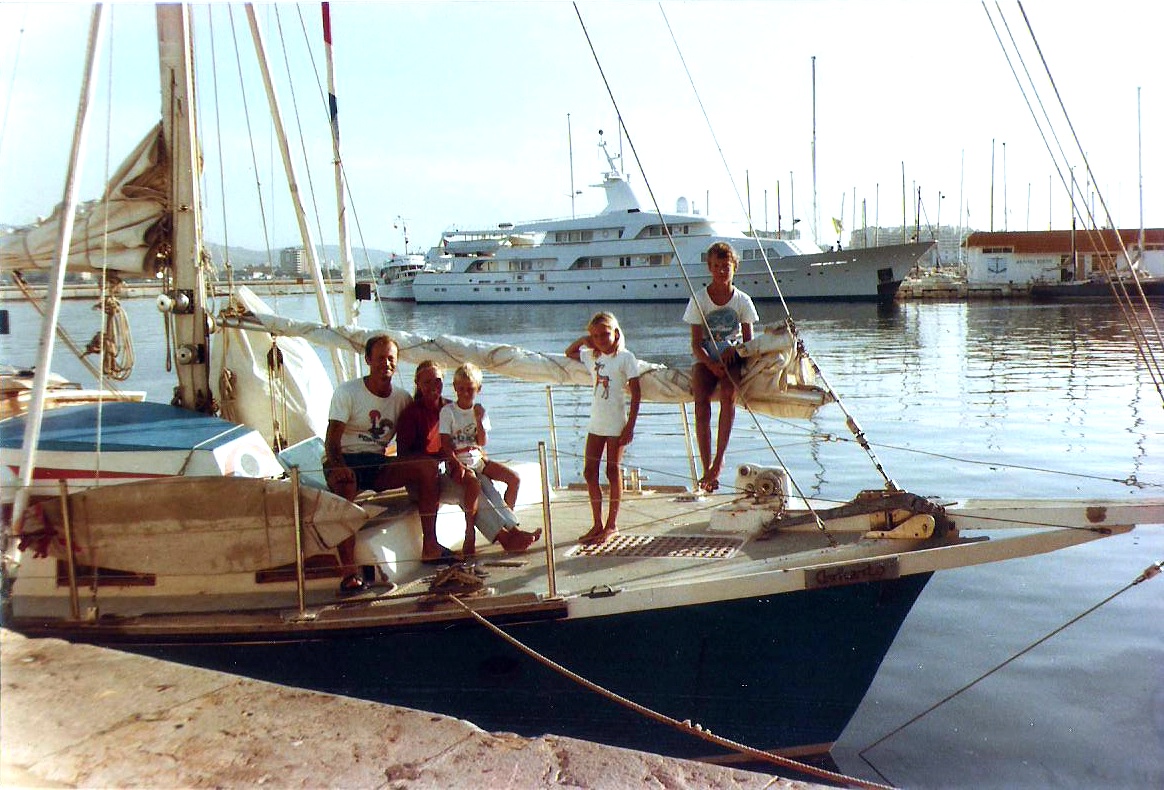
010 In good company — with the Saudi royal yacht El Pharaon behind.
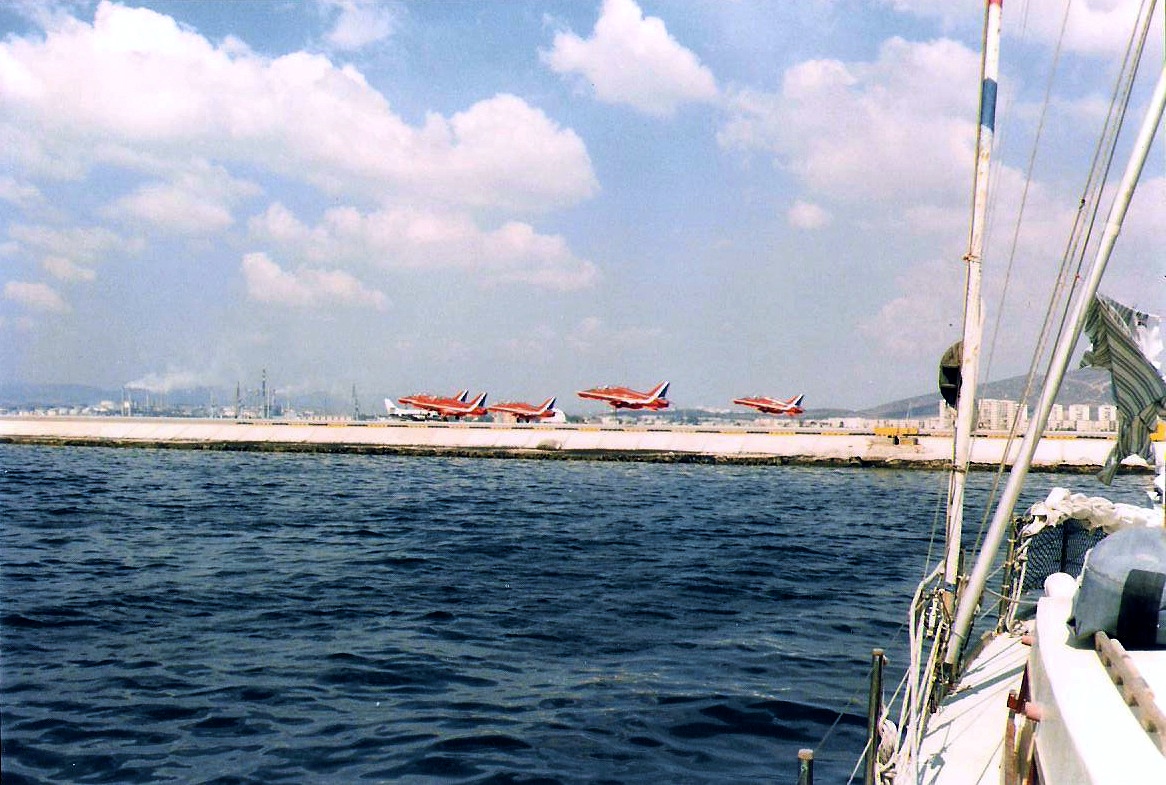
011 Gibraltar — the Red Arrows over the runway next to Marina Bay.
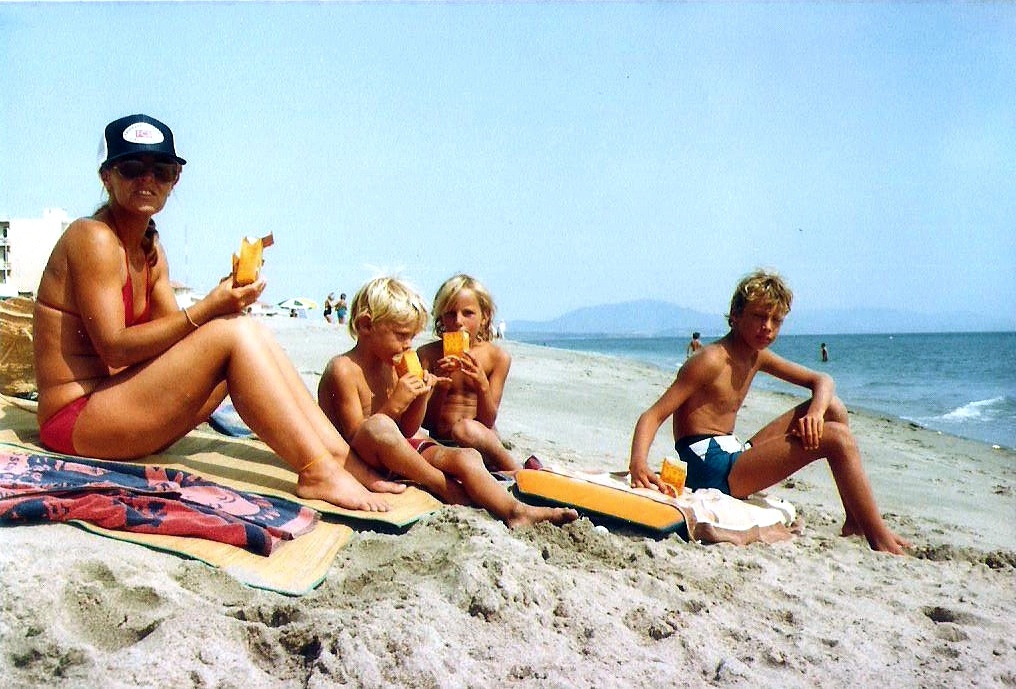
012 Eastern Beach, Gibraltar.
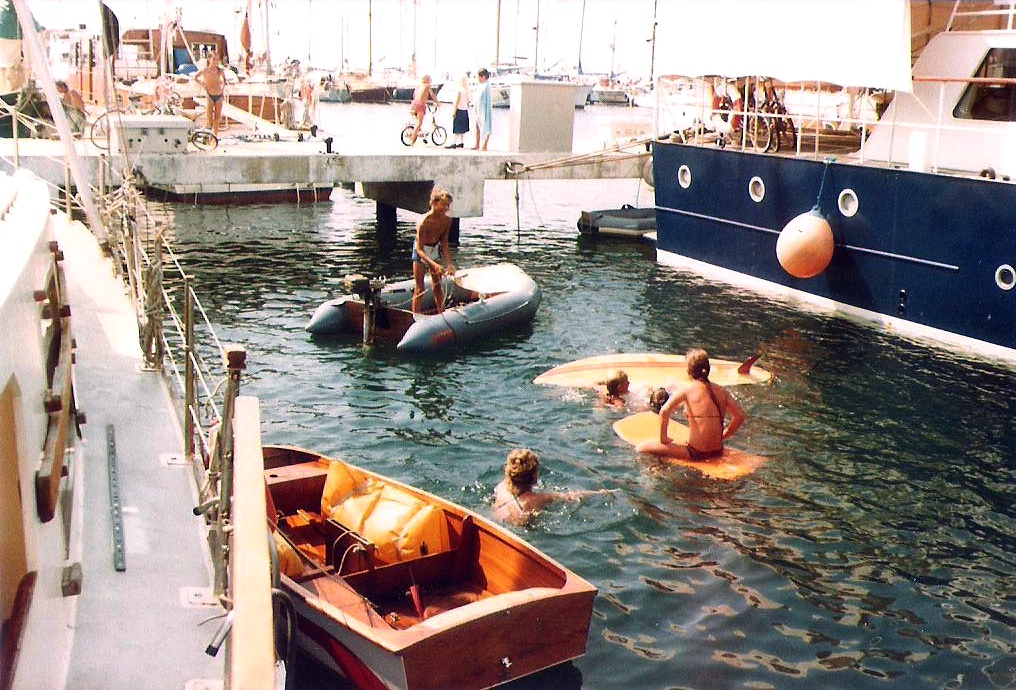
013 With the marina children, Gibraltar.
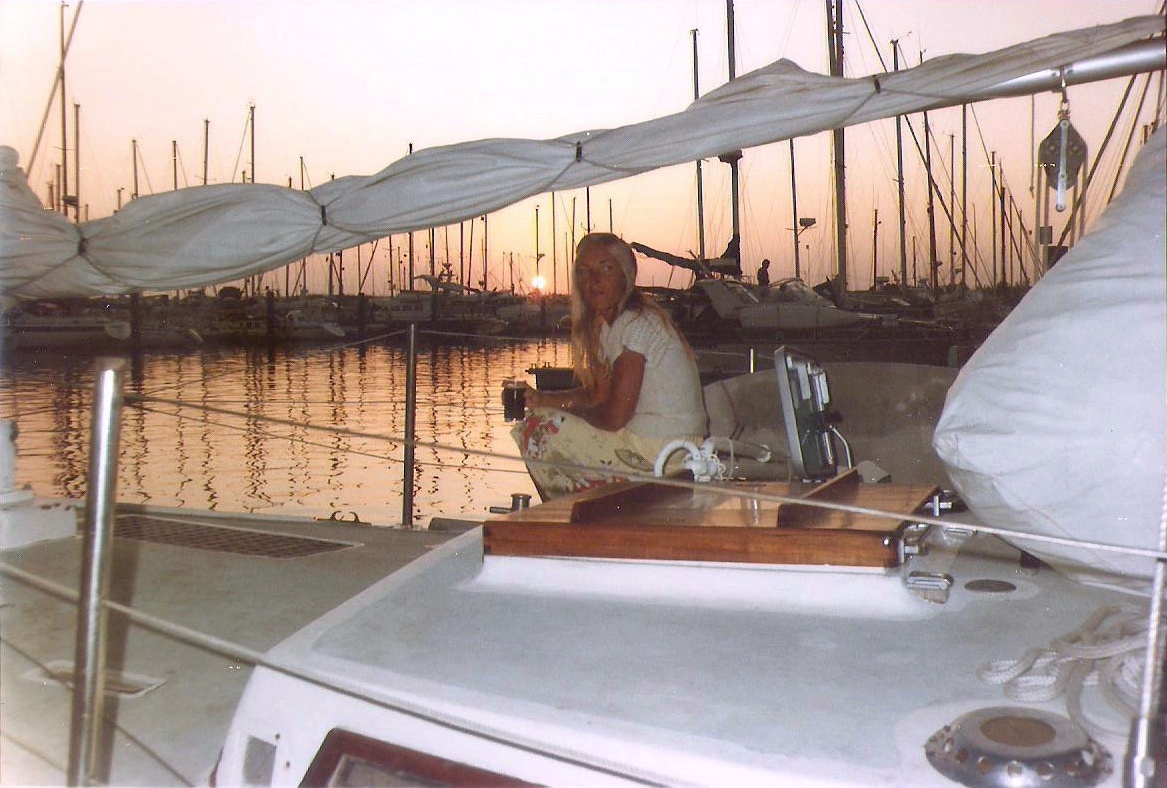
014 My mother, evening, Marina Vilamoura.
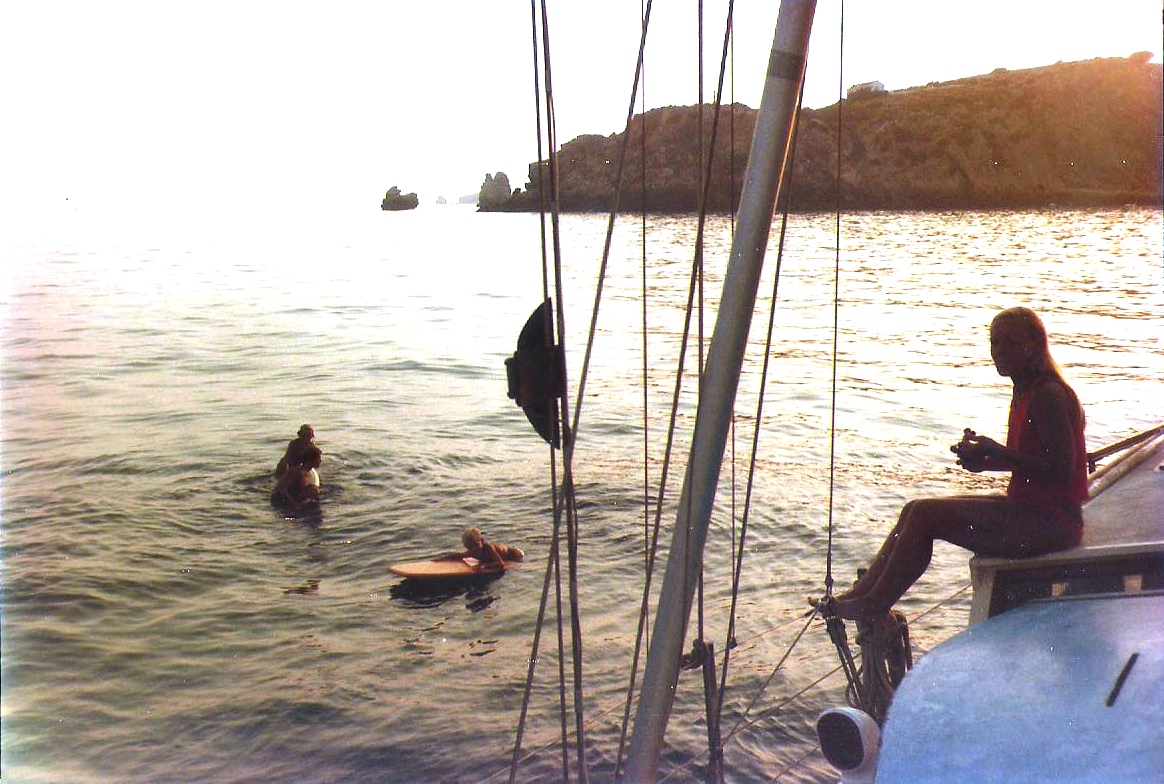
015 An evening dip at anchor.
We made Porto Santo seven days later and dropped anchor next to a yacht called Zuleika. Zuleika belonged to Patrick Green, an old friend from England we hadn't seen in four years. He had no idea we were sailing this way. We had no idea he was. He'd sailed in from Cornwall ten days before us.
A few days later in Funchal we anchored ahead of Flagon, owned by Ed Davies of Durban. In such an immensely vast world, sometimes it shrinks.
All of us — the family and Patrick — hiked Madeira to the Pousada at Pico Ruivo, the highest peak on the island, where we slept above six thousand feet in November. Antony was a furnace at night — always a few degrees warmer than the rest of us — so we used him as a hot water bottle and warmed each of our beds in turn. He approved.
The next morning it was raining. We had no wet weather gear. We cut head and arm holes in plastic bin bags and walked down the mountain in those. They didn't really work.
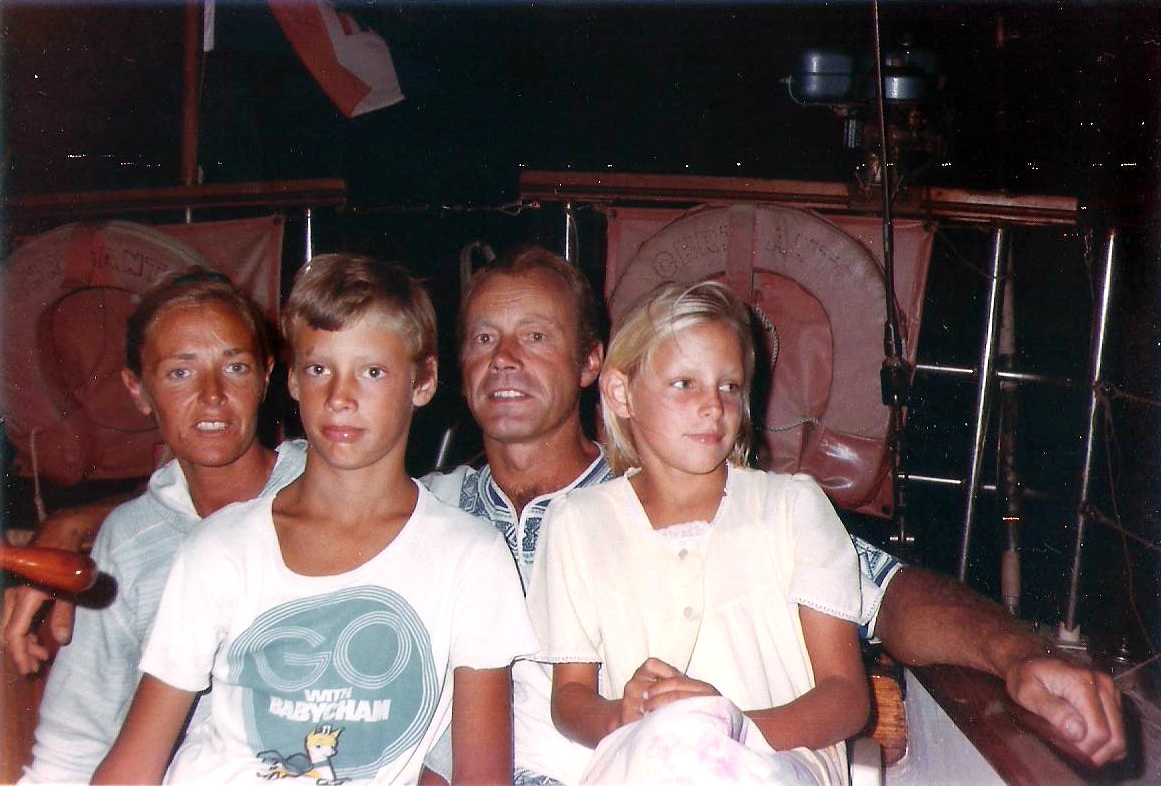
016 Margaret, me, my father, Candice — in the cockpit.
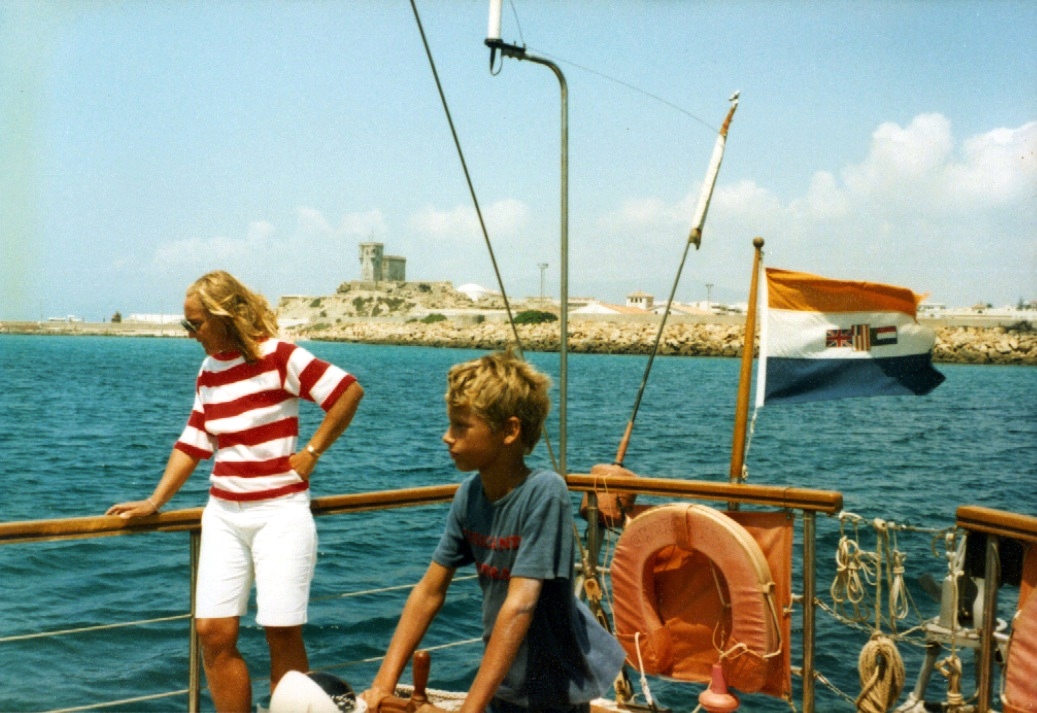
017 At the helm, southern Spanish coast.
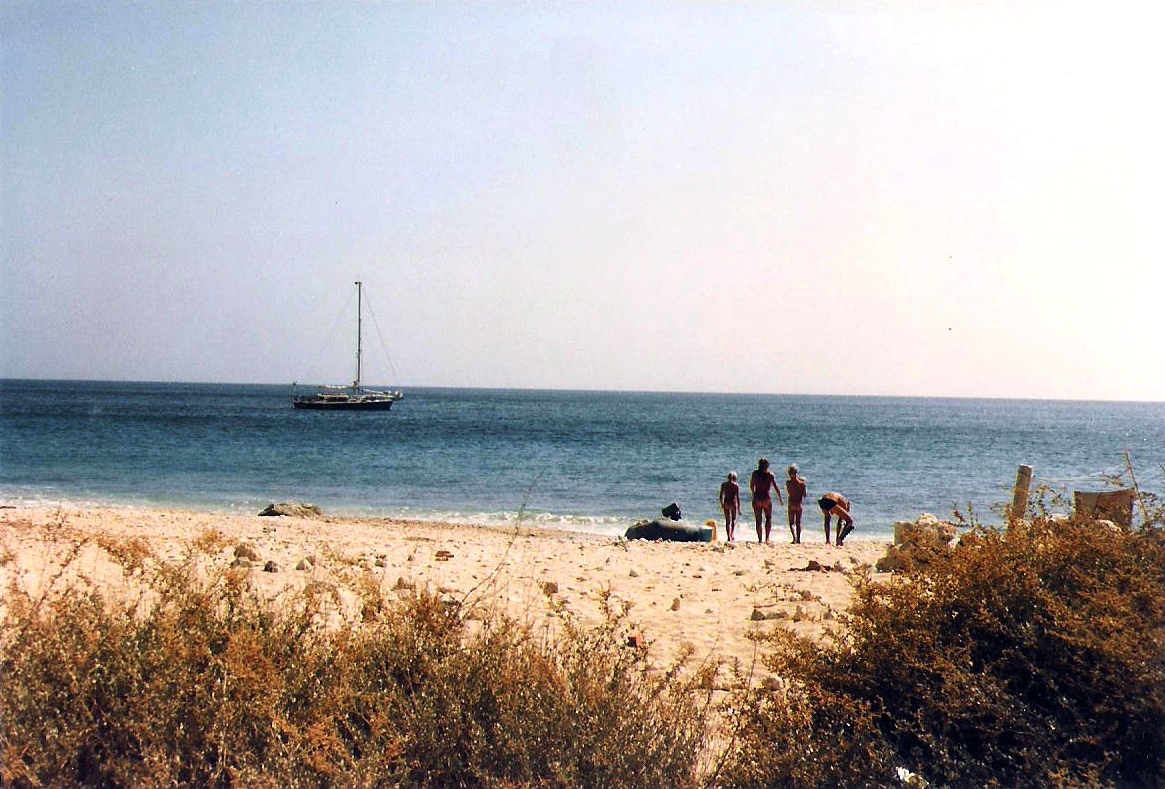
018 Peacefully at anchor, Mordeira Bay, Ilha do Sal.
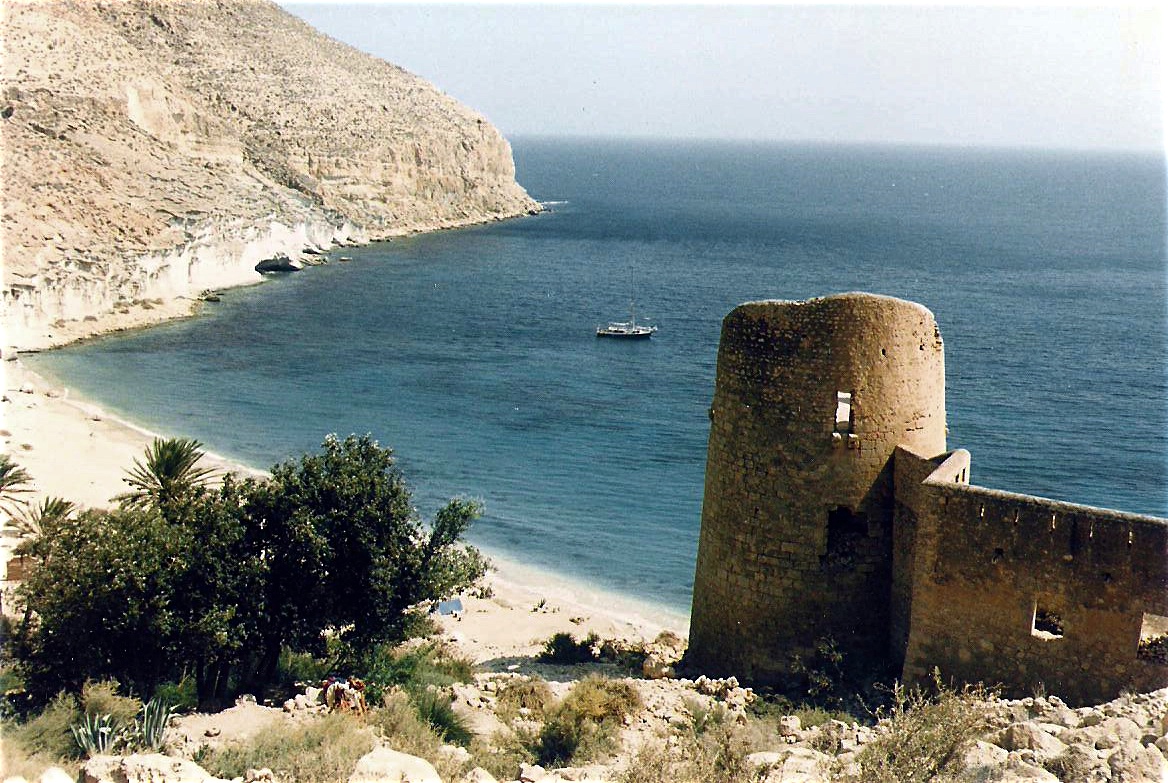
019 Anchored off Castillo de San Pedro, southern Spain.
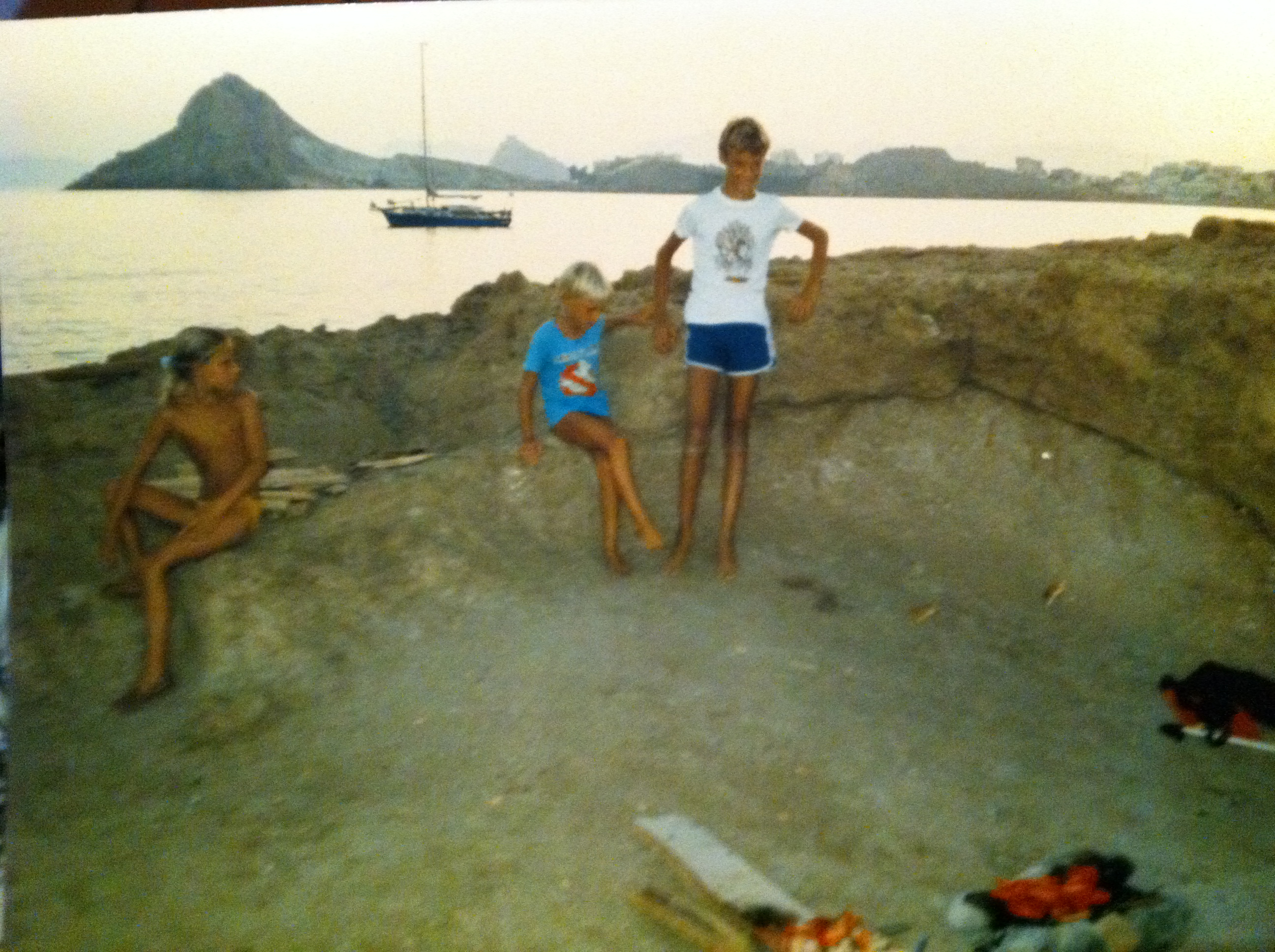
020 Spanish coast at dusk. Candice, Antony, me.
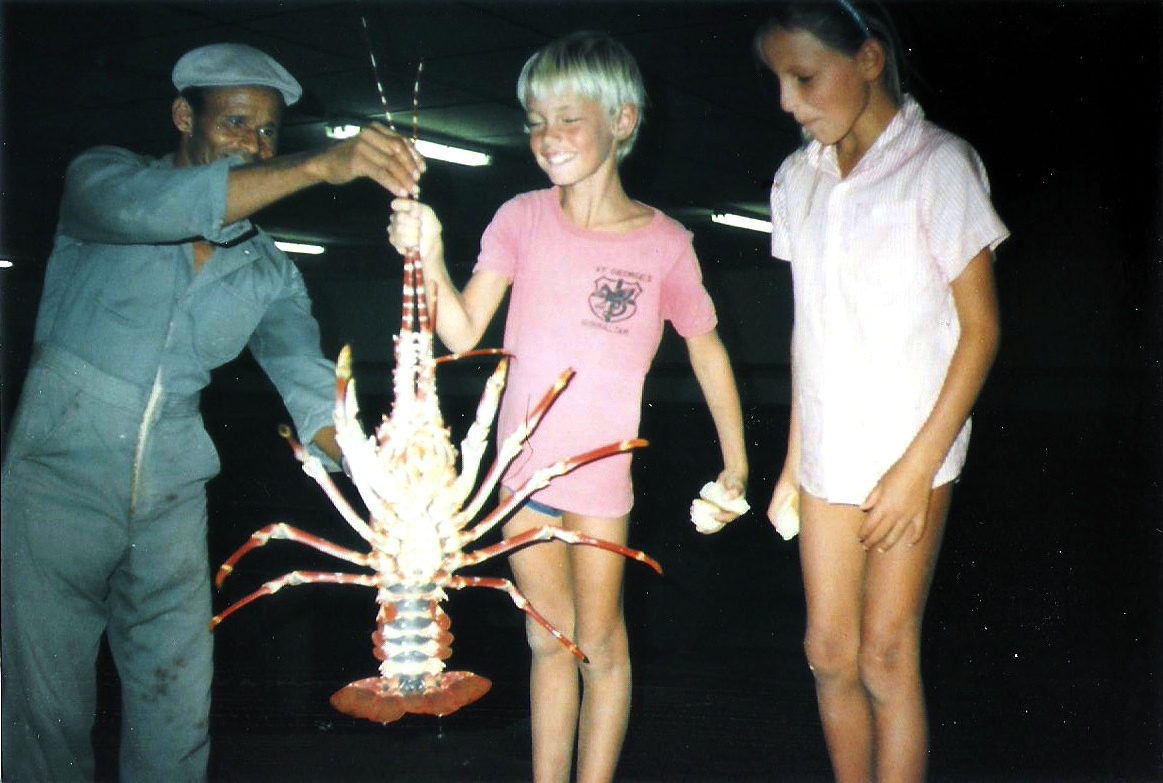
021 Antony with a three-and-a-half-kilogram crayfish.
We headed for La Palma. Four hours out we ran into a south-west gale and diverted to Santa Cruz de Tenerife instead. Spent a week there, then sailed down the coast to Los Gigantes — a tiny marina at the foot of vast cliffs, the surf breaking right across the entrance, requiring careful timing to slip through.
Then La Gomera — the only Canary without an airport. Leaving her, the trade winds picked up. Seven boisterous days under twin running headsails took us to Ilha do Sal in Cape Verde.
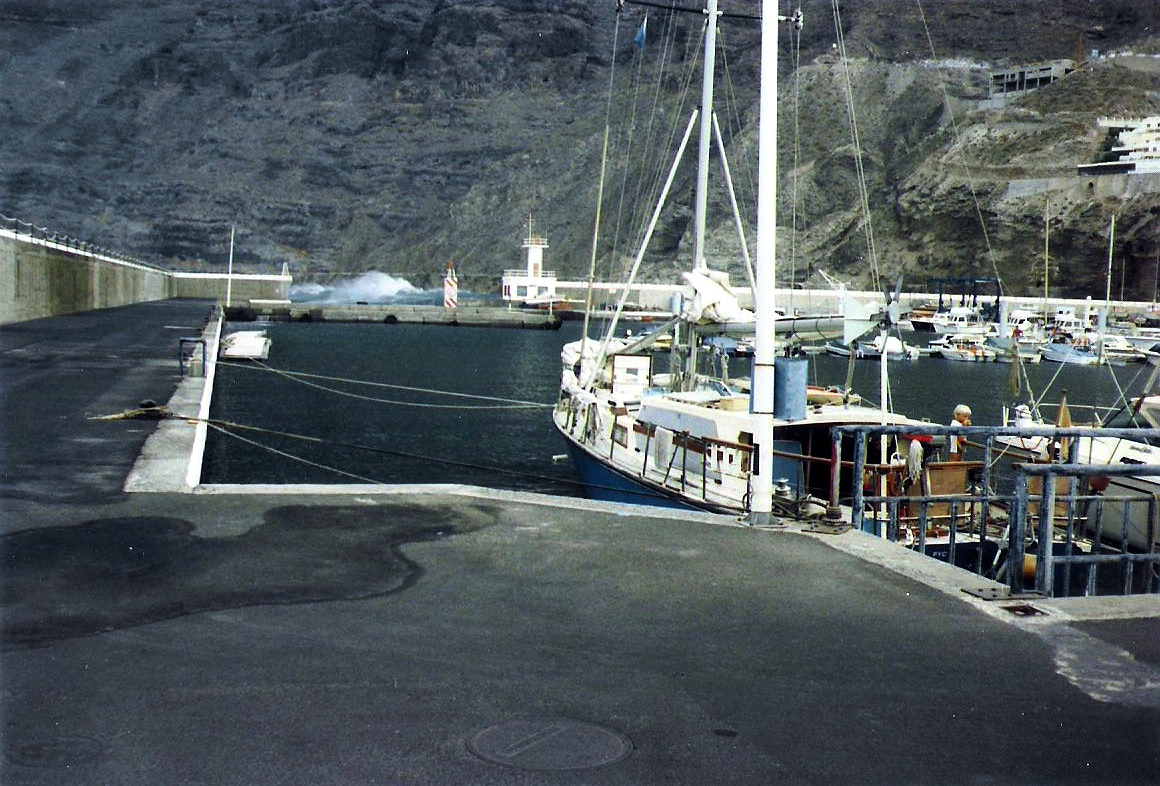
022 Safely alongside in Los Gigantes, Tenerife.
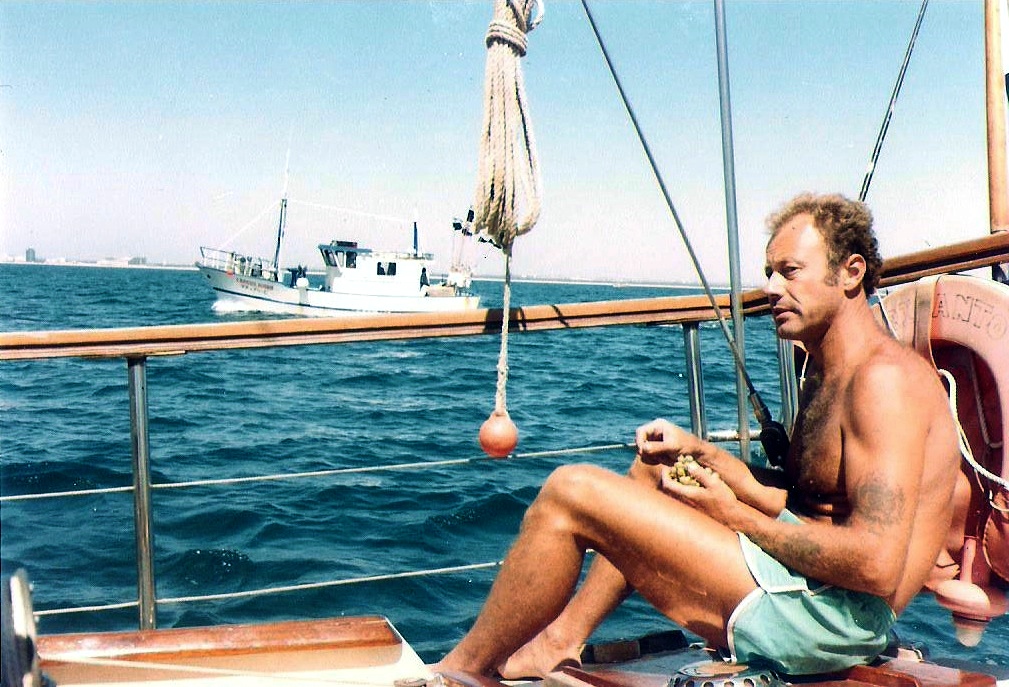
023 Skipper feasting on grapes — Portuguese coast near Lisbon.
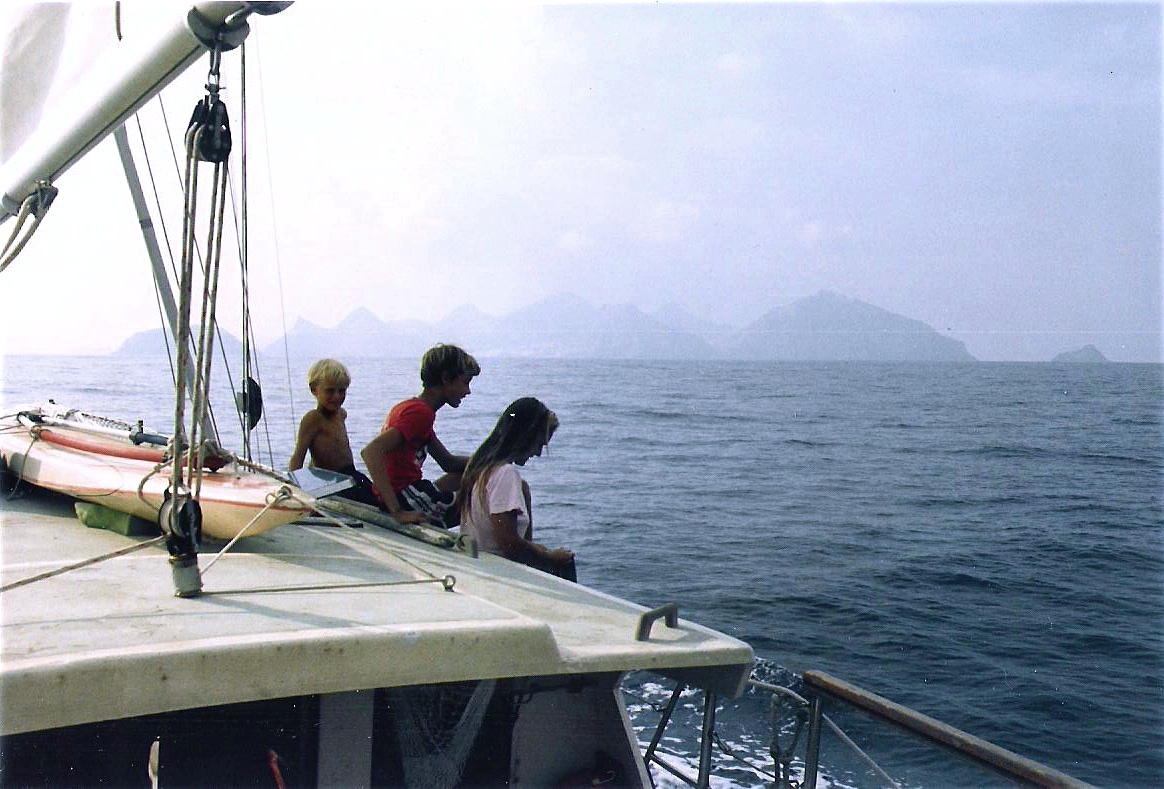
024 Approaching the eastern tip of Porto Santo.
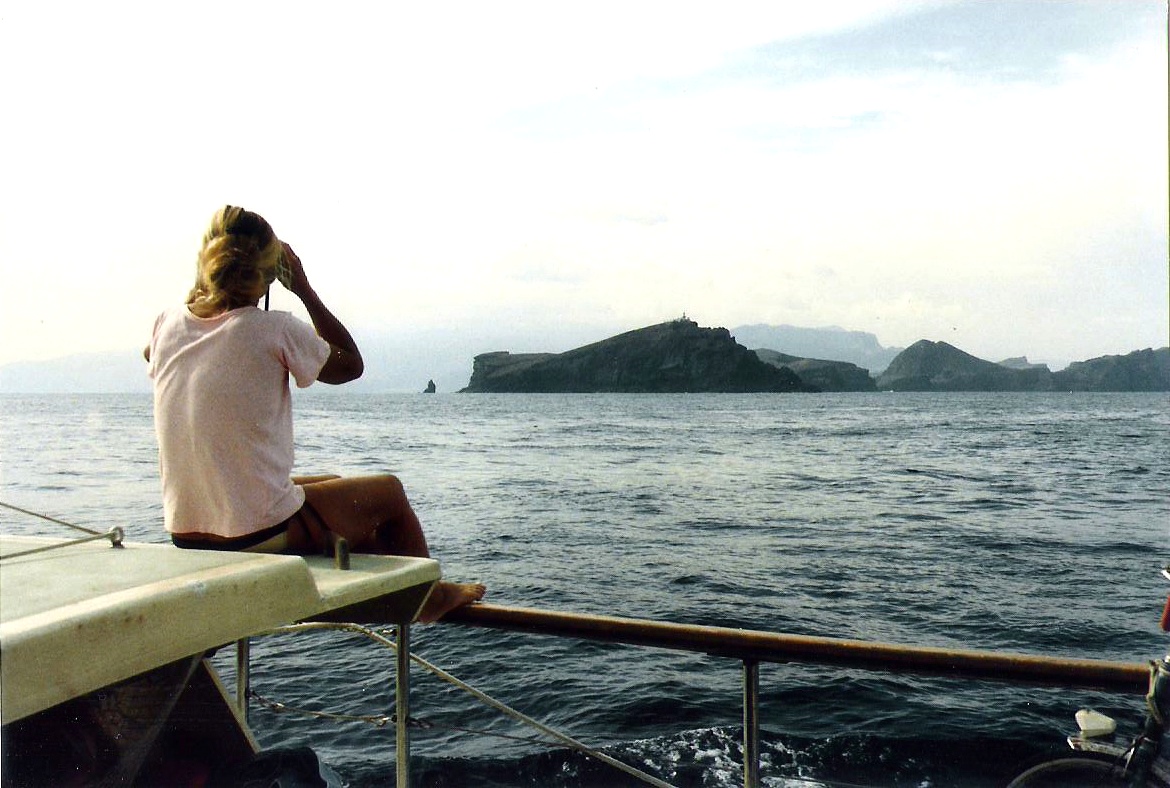
025 Cooling off east of Adra — fireworks for Our Lady of the Sea that night.
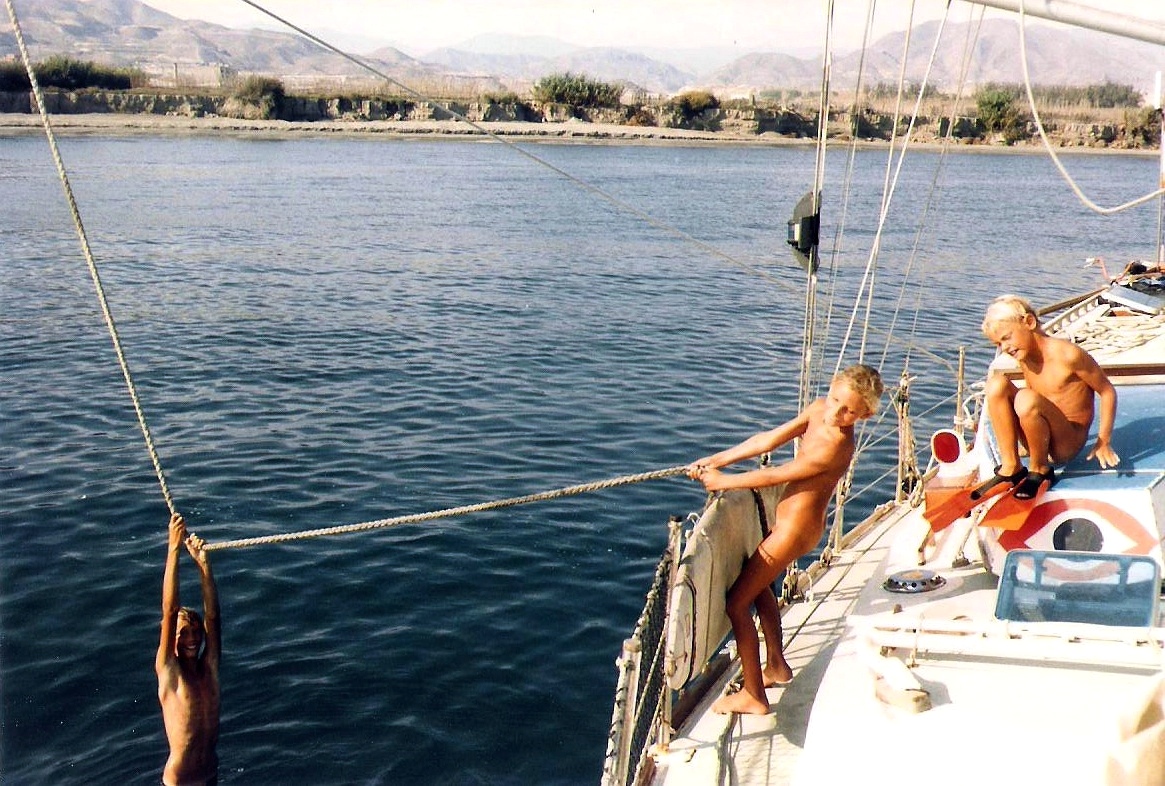
026 A small Spanish harbour where we rested for the night.
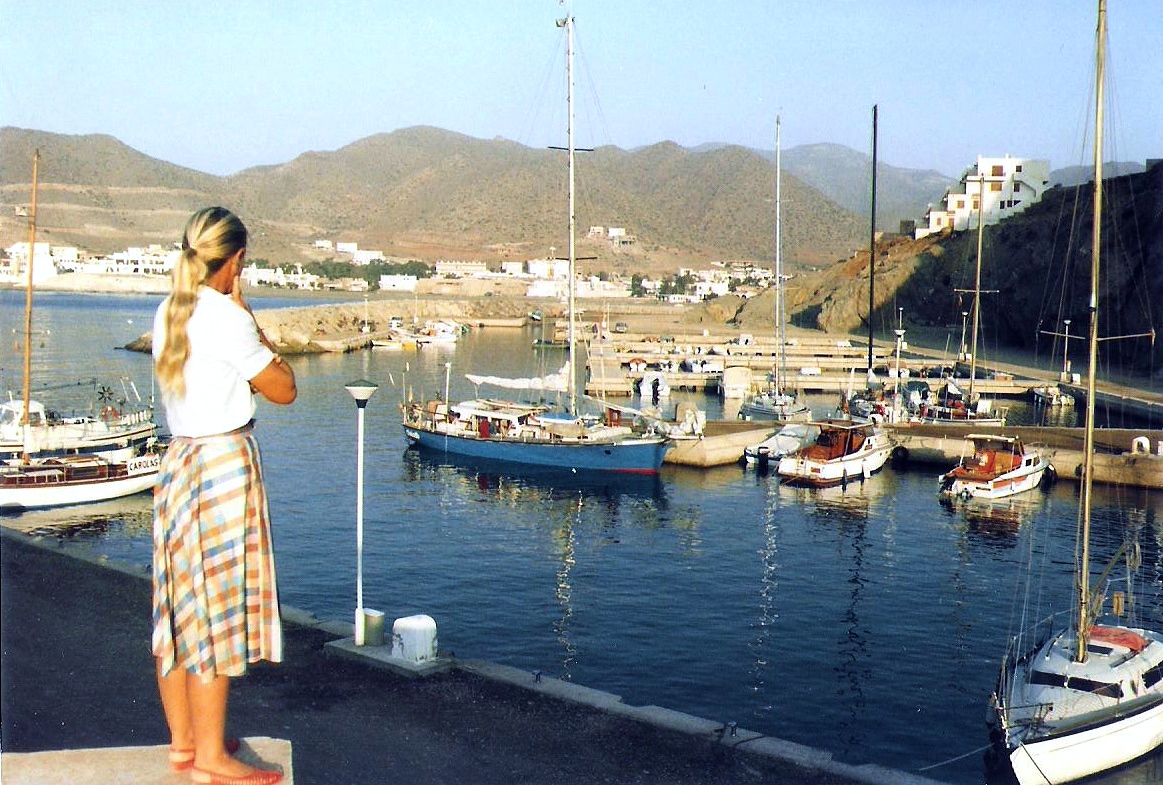
027 My mother at the helm leaving Funchal, Madeira, for the Canaries.
Ilha do Sal in 1986 was a transit stop for South African flights. Most African countries had closed their airspace to us; the route to Europe had to go round the bulge of West Africa, and South African Airways broke its journeys here. The SAA office sat between Aeroflot and Cubana at the airport.
The Cape Verdeans were the kindest people we met on the entire trip. Every passing vehicle on the island stopped for us — not slowed, stopped. The SAA technicians took us round the island, showed us the salt mine in the extinct volcano cone and then kindly fed us lobster.
While we were there I stubbed my toe in the water. It turned into blood poisoning. Dark veins started climbing up my leg like a tideline you could watch advancing — visible against the skin, slow, going the wrong way. The whole foot went dark. I ran a high fever. There was no hospital on the island. Margaret did not panic. She started me on antibiotics and sat with me. The tideline stopped advancing. The fever broke. The colour came back.
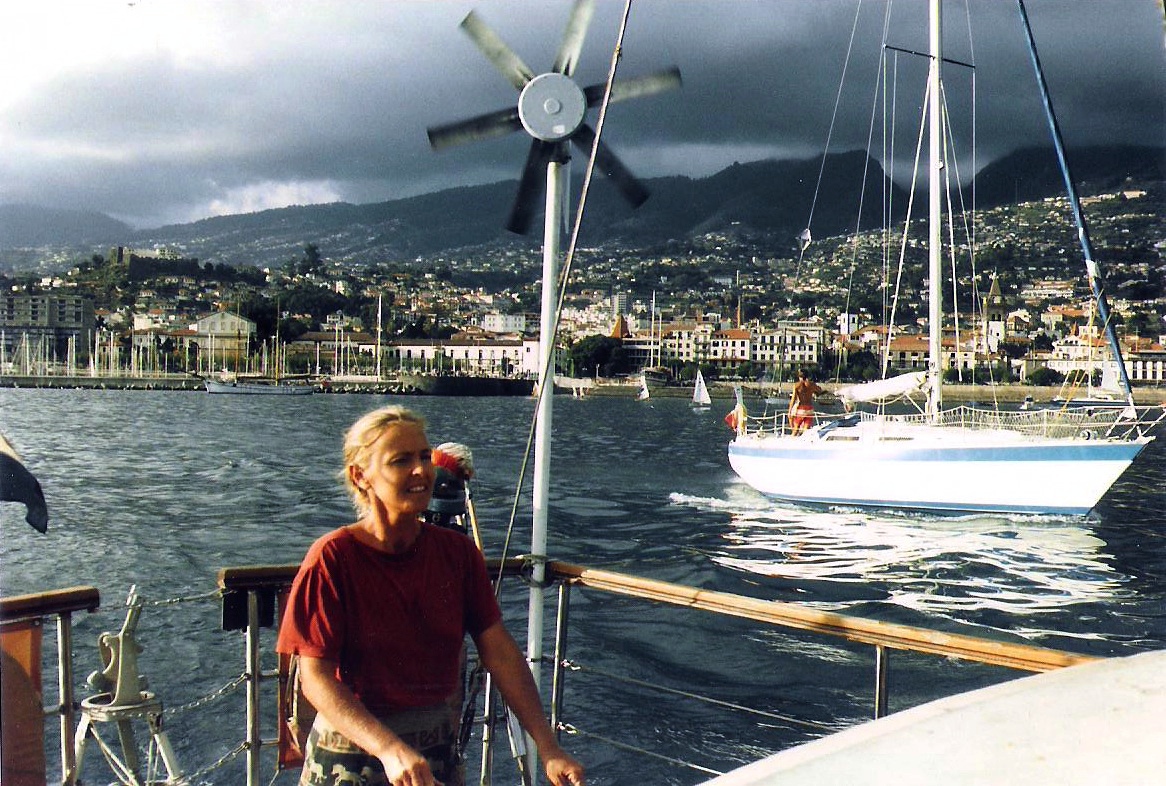
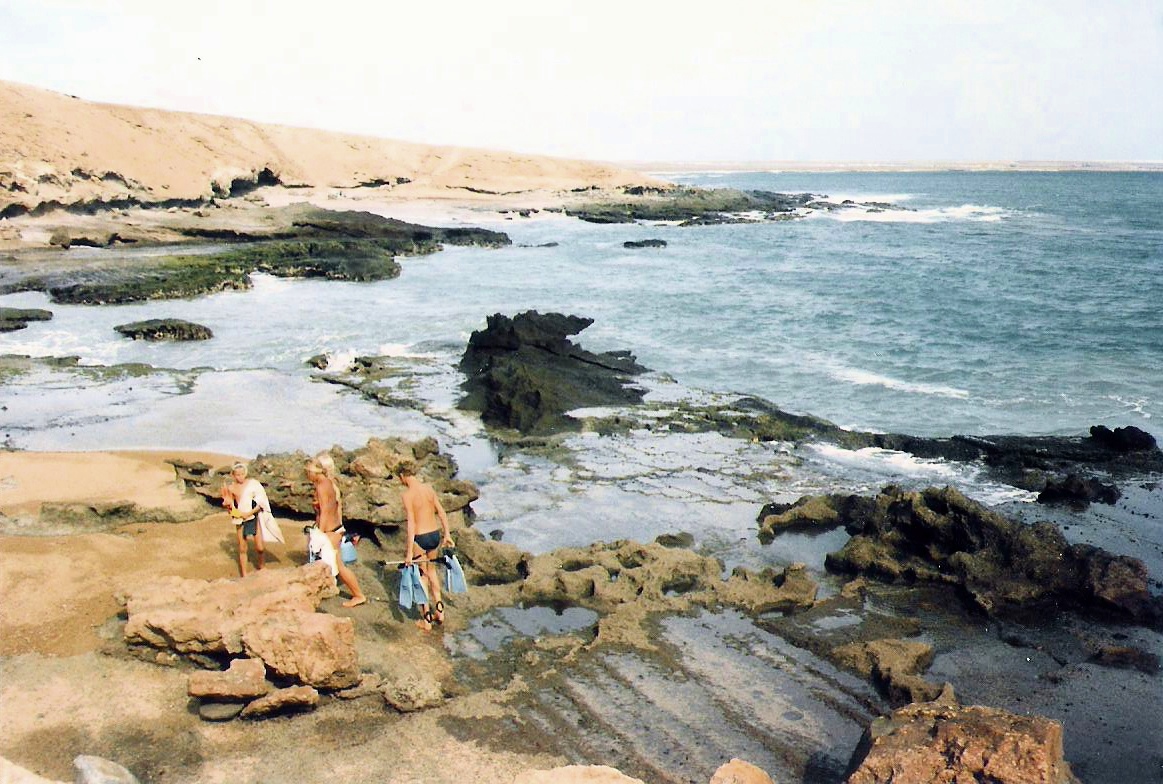
028 Walking back from snorkelling, Baia Mordera, Ilha do Sal.
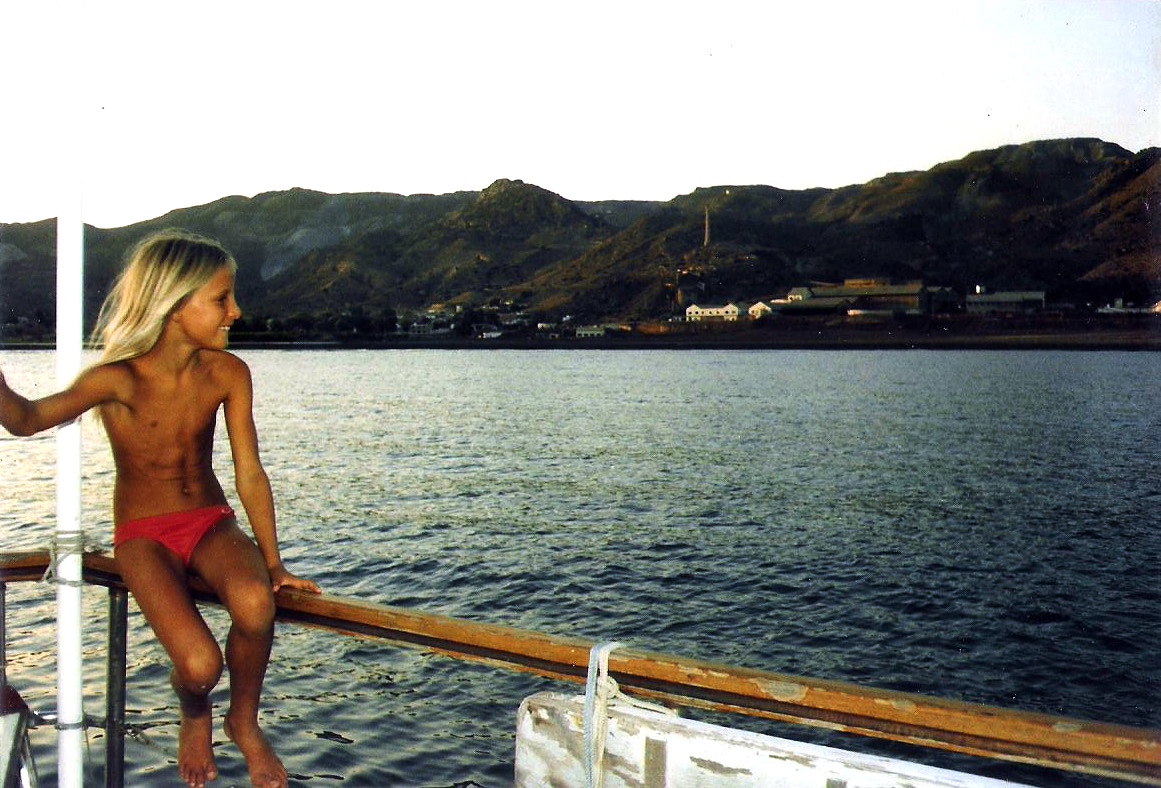
029 Candice watching southern Spain slip by in the evening.
030 Dramatic cliffs at Sal — we snorkelled for crayfish at the foot of these.
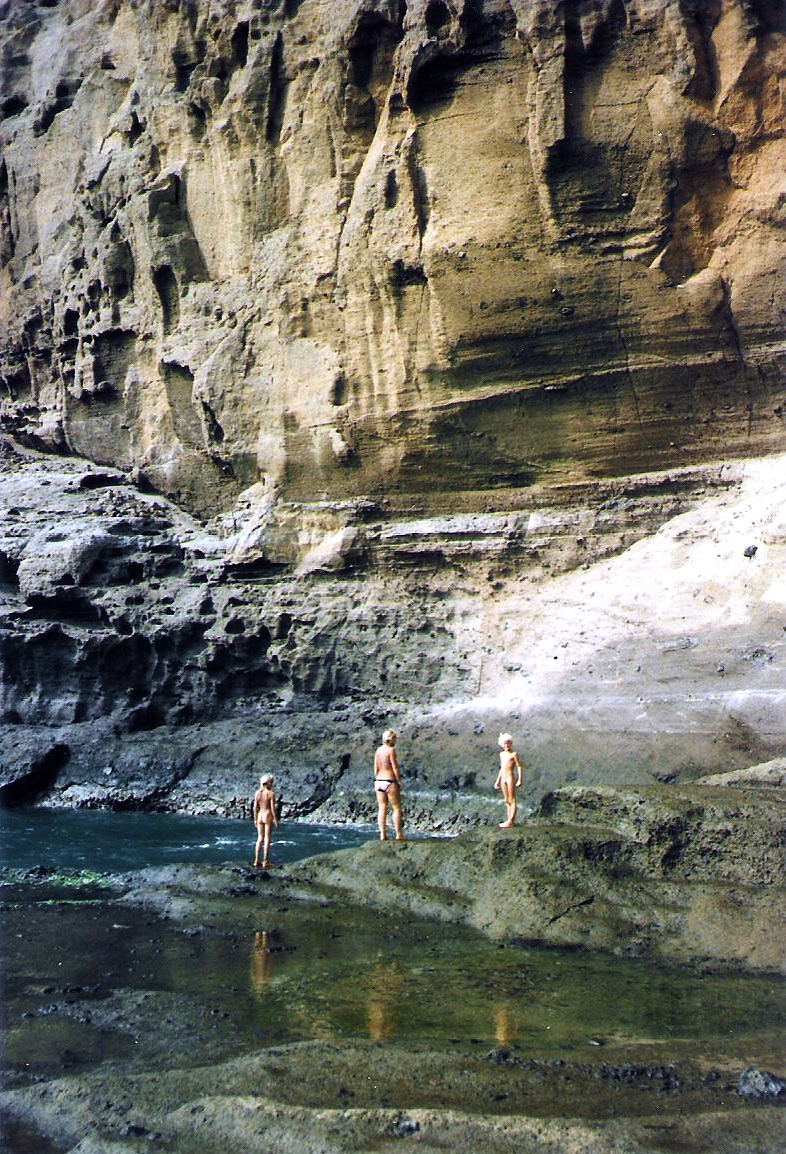
031 The cliffs at Sal.
We left Sal under a hot, dry wind from the east. By morning there were little sand dunes on our deck. The Sahara had blown across to meet us in mid-Atlantic.
We crossed the doldrums without resorting to motoring. When the wind died completely we'd jump off the side and swim alongside the boat, someone always keeping lookout from the cockpit. The only thing I remember finding strange about it was that there were sometimes thousands of metres of water below me. It was the abstract amount of it, more than anything that lived in it.
Once, swimming, my mother said in her calm voice that perhaps we should get back on board now. We climbed up the boarding ladder one by one. From the deck she pointed out two large fins, twenty metres away. The sharks swam past us slowly and disappeared. We refrained from swimming for a few days.
Eighteen days from Sal, twenty dolphins shepherded us into the anchorage at Fernando de Noronha.
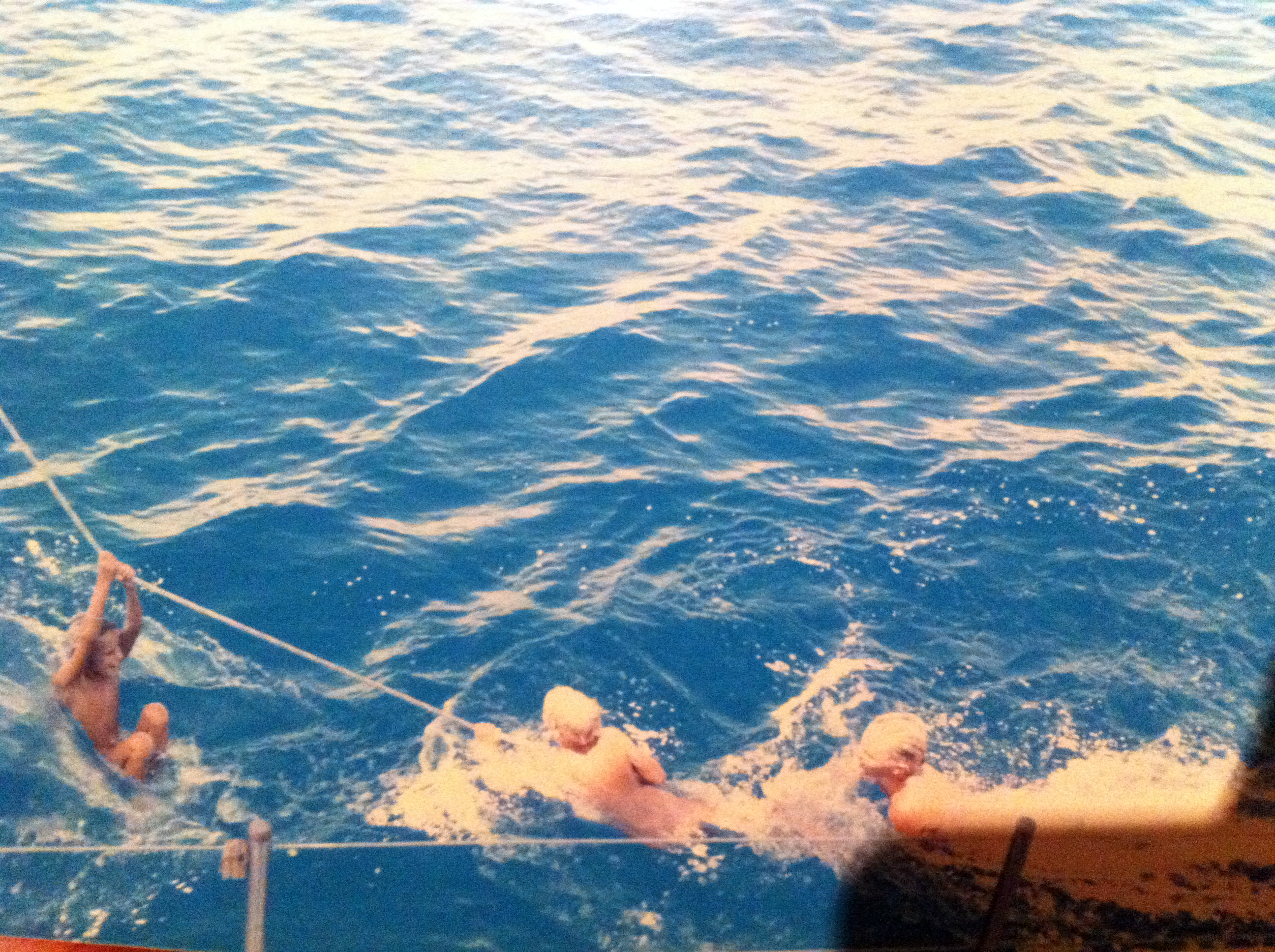
033 Swimming alongside. Two thousand metres of water beneath.
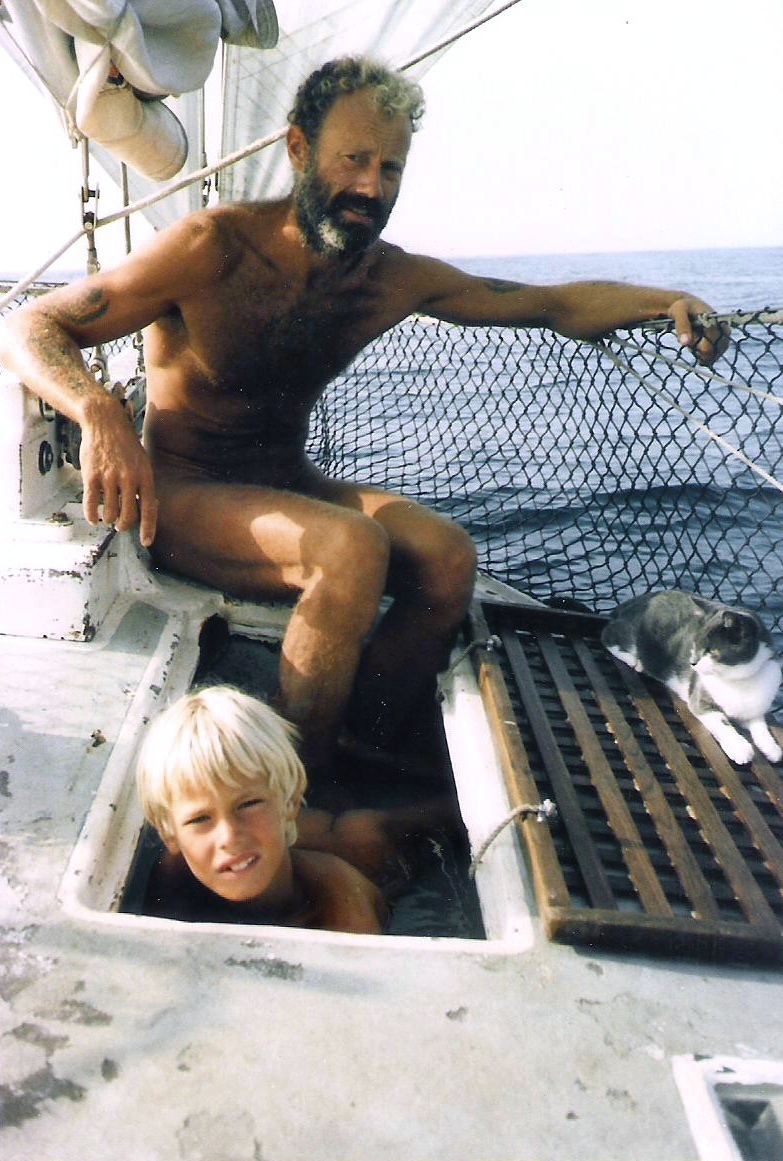
034 Skipper looking weatherbeaten, Antony cooling off, Pusskins on the lookout.
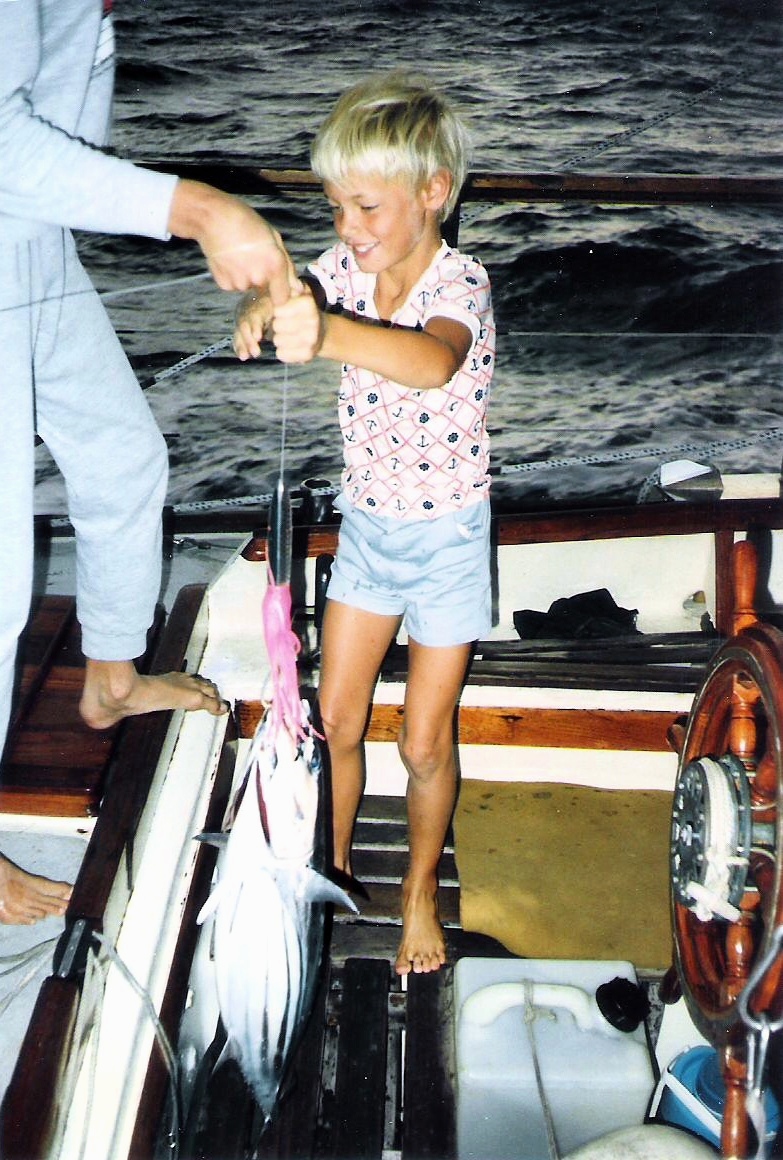
035 Antony in the cockpit with a tuna caught on the way to Tristan.
The Brazilian Navy ship Almirante Guilhem invited us aboard for dinner. The ship's company gave us their entire ration of ice cream. Their football team won a televised match while we were on board and they fired green flares to celebrate. It was the warmest reception we got from any navy on the voyage.
We sailed for Recife, where we celebrated Christmas at the Iate Clube. While we were at Fernando the exchange rate had been ten thousand cruzeiros to the dollar. A week later in Recife it was fourteen thousand. I changed a hundred-dollar bill and walked out with one and a half million cruzeiros in my pockets. On 30 December we sailed back into the Atlantic with three thousand three hundred and seven nautical miles ahead of us.
On 17 January 1987, at 29° 53′ S, 24° 12′ W — about 1,200 nautical miles from South America, 740 from the nearest landfall — a line squall came out of the southeast at half past one in the morning.
It happened almost as soon as my father had closed his eyes. The genoa pinned aback. The deck went over. The mast — sixty-one feet of it — came down across the port side. The wind died as suddenly as it had come, leaving an eerie silence. The mast was thumping the hull. For the first time in six years aboard, my mother was thrown out of her bunk.
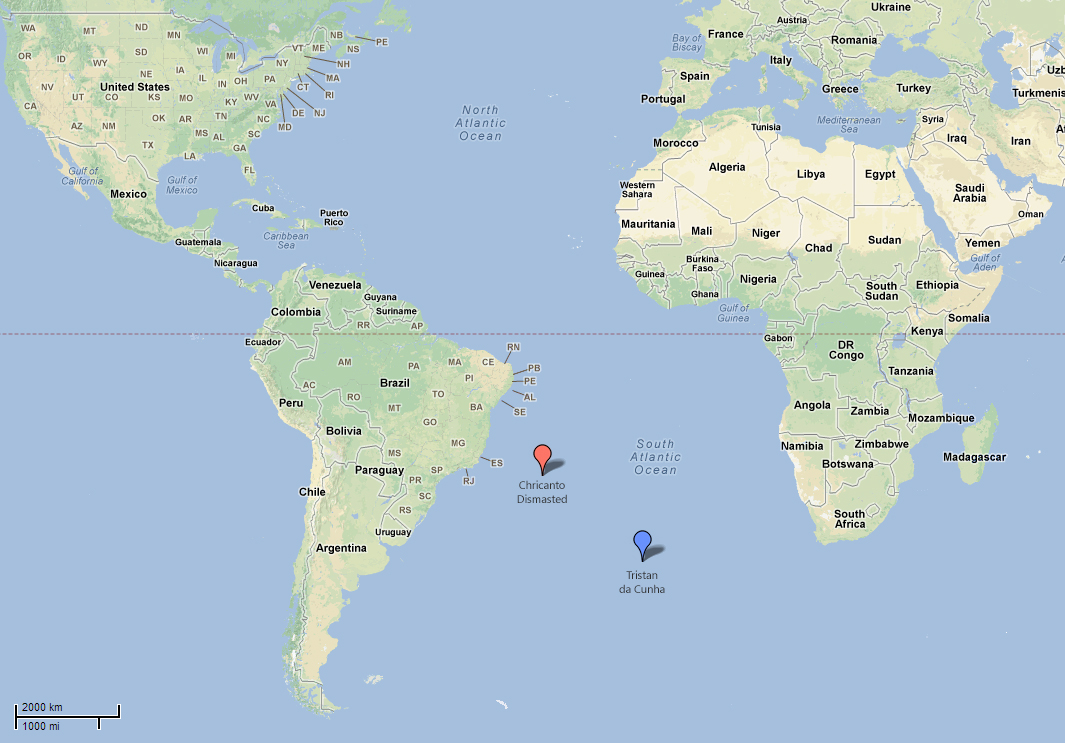
036 An exact view of where we were dismasted, and where our only hope for survival lay.
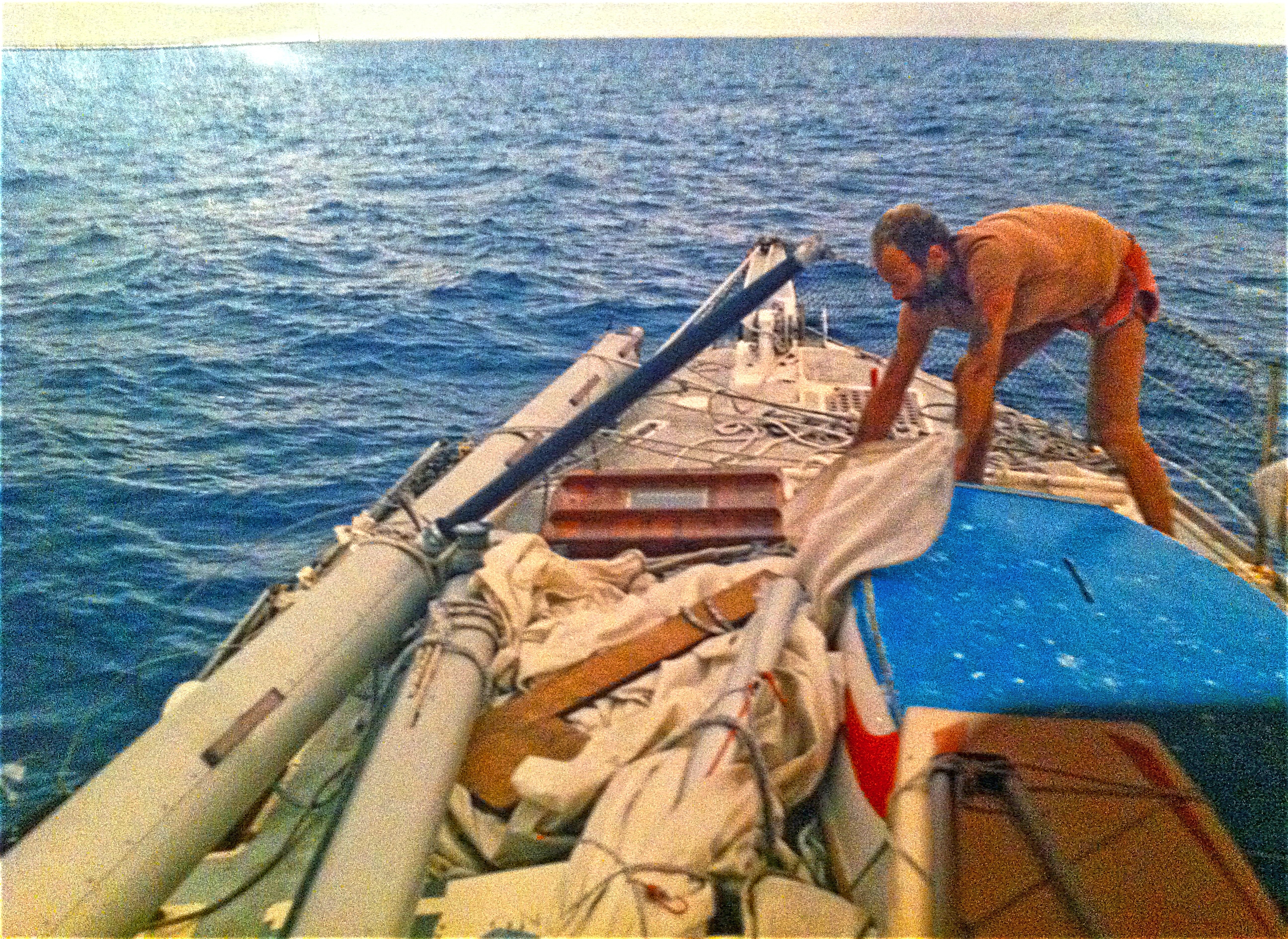
037 The morning after. Clearing the deck.
My father drew a circle of two hundred miles — the radius of our remaining fuel — centred on Tristan da Cunha. Tristan was 740 nautical miles south. The chart he used was the one he had purchased on a whim in Gibraltar.
A white-tipped shark turned up at first light and stayed with us for two weeks. He kept us out of the water.
We spent the next three weeks under jury rig — modified trysail for a main, two cut-down jibs poled out forward, a storm jib hanked upside-down on a backstay. The first day under jury rig we logged sixty-seven miles. After that the runs collapsed to five or ten a day. The rig was useless to windward.
Seventeen days in, a ship appeared. I broke out the distress canister. My father fired eight parachute flares, four hand-helds, and a smoke float. My mother called on channel sixteen. The vessel — an Asian fishing boat, white hull, "apparently devoid of life" my father wrote in the log — steamed on by and disappeared.
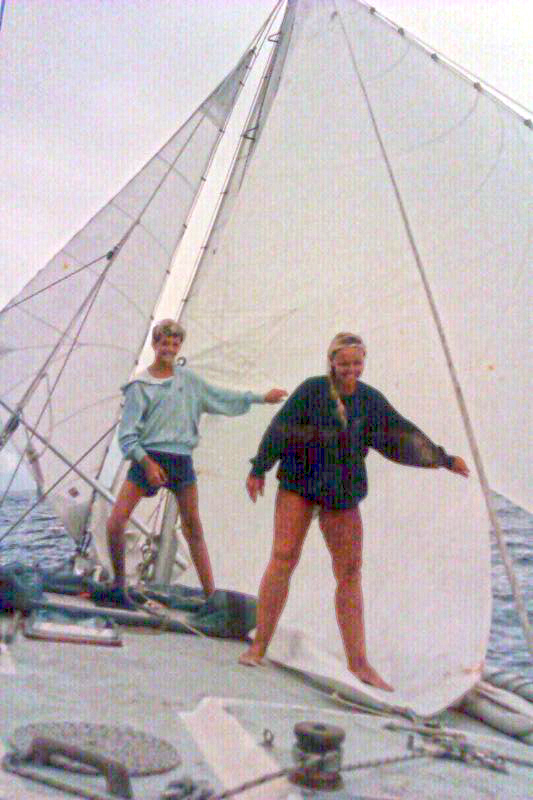
038 My mother and me with the jury rig hoisted. Sixty-seven miles the first day.
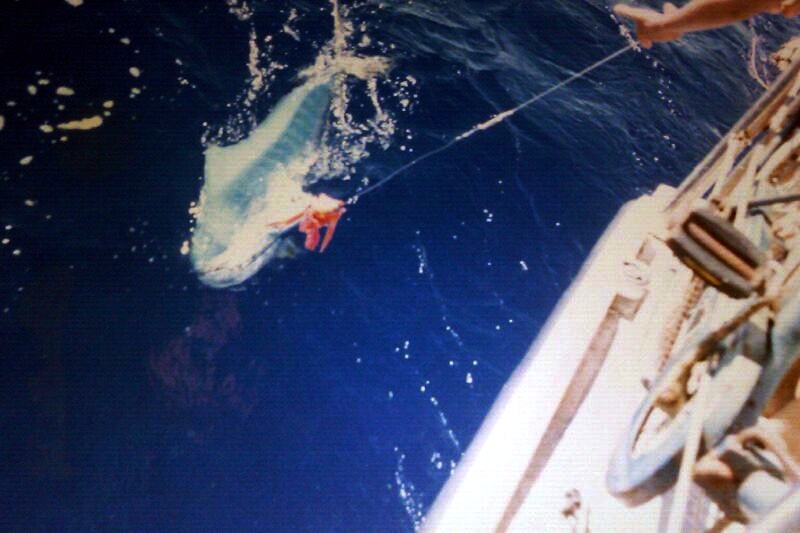
039 A dorado for supper.
On the morning of the seventh of February I went looking for the hake we had been saving for landfall — a tiny one, about the size of a child's hand, that had followed us for weeks, nibbling weed off the transom. It was gone. The rest of the family had cooked and eaten it for breakfast while I slept. I have not entirely forgiven them.
That afternoon at 15:15 the mist cleared and the symmetrical cone of Tristan da Cunha rose dead ahead, fifty-five miles off, with cloud wreathing the peak. Our navigation had been spot on.
A launch came out through rough seas to meet us. After forty days at sea I spoke to people who weren't my family for the first time. On the quay we met the Administrator, Roger Perry. We'd made a deal with the children that as soon as our feet touched dry land we'd open the bottles of Brazilian Guarana we'd been saving for the purpose — bottles that looked exactly like beer. We drank them on the quay at seven in the morning. The islanders gave us some very strange looks.
The ground didn't stop heaving for days.
My father decided not to attempt another fifteen hundred miles to Cape Town in a leaking, jury-rigged yacht. We stripped Chricanto of everything of value. The island government bought most of it. Then they beached her on the rocks. By the time we left three months later, she'd begun to break up.
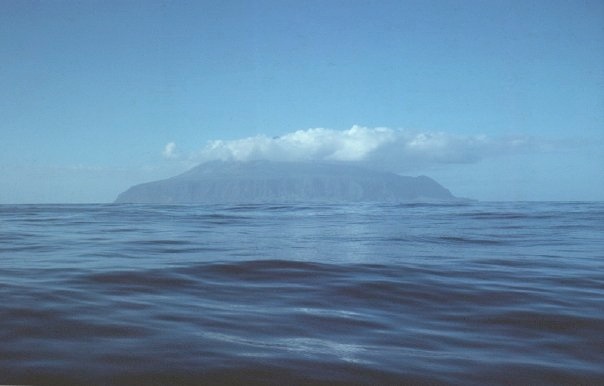
032 Tristan da Cunha from the sea — first sighting.
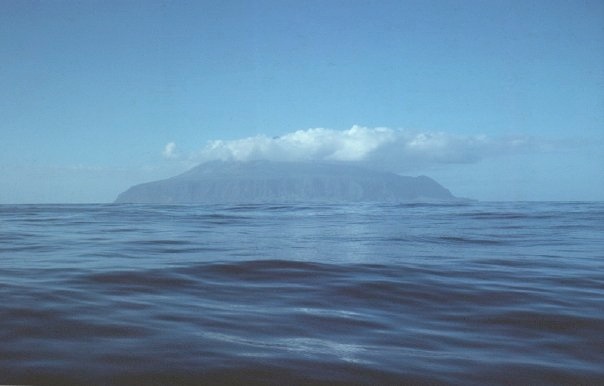
040 Tristan da Cunha bearing 075, distance 8 nautical miles.
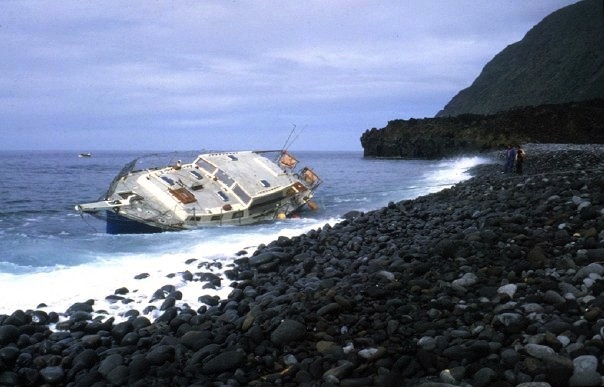
041 The ignominious end. Hauled up on the rocks east of Boatharbour.
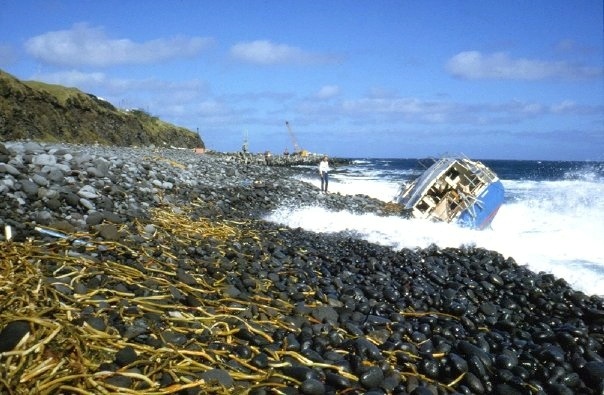
042 The final demise of Chricanto.
There are 350 people on Tristan da Cunha. They share seven surnames between them. Until the war they were paid in potatoes.
We lived in a wooden bungalow above Boatharbour in the company of Calum the doctor, David the Padré, and Jim the senior schoolteacher. Pusskins was the only cat on the island. The children had never seen one. The cattle, who had no frame of reference, found her sufficiently alarming that a cow actually ran away.
I attended St Mary's school. I made friends with the island kids — Ian, Dan, the rest of them. We climbed Pigbite to the Ponds. We took the island launch eighteen miles south-west to Nightingale for a day. On 22 April we helped tow the longboats out for the annual fatting trip. The trip was supposed to take five days. Bad weather kept them on Nightingale for a month. They came back fine.
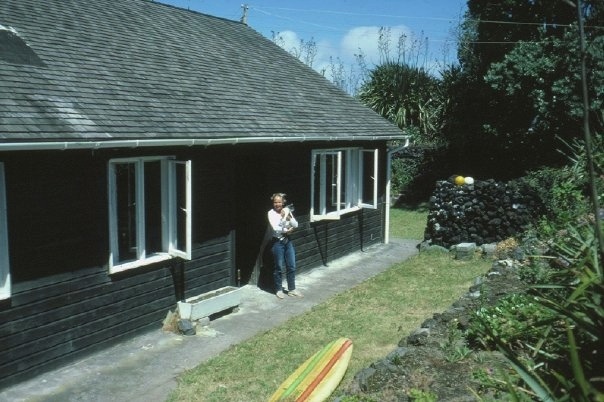
043 The bungalow allocated to us. Used by scientific expeditions from time to time.
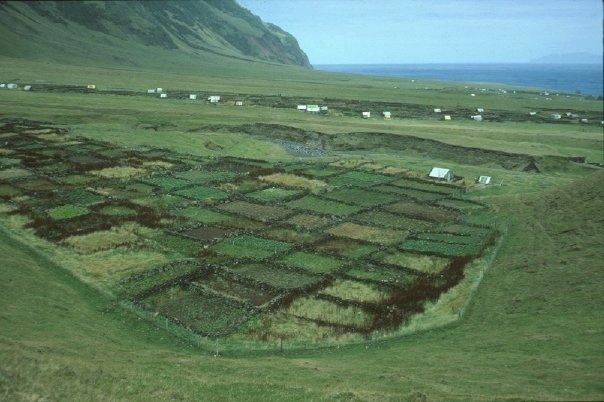
044 The all-important potato patches, with Inaccessible Island in the distance.
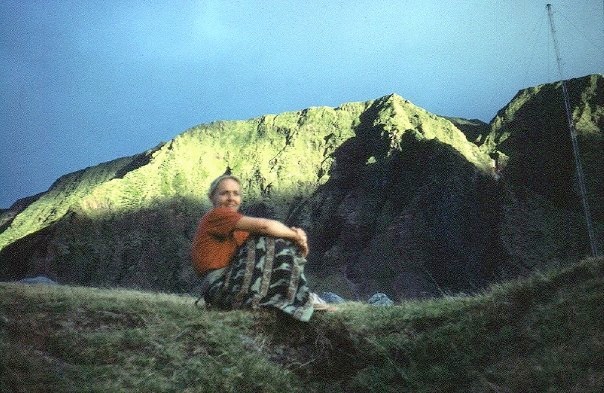
045 My mother with Pigbite behind — on the way up to the Ponds.
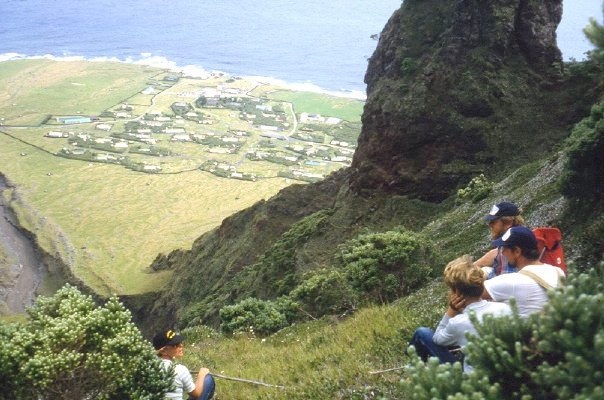
046 The settlement from upper Hottentot Gulch.
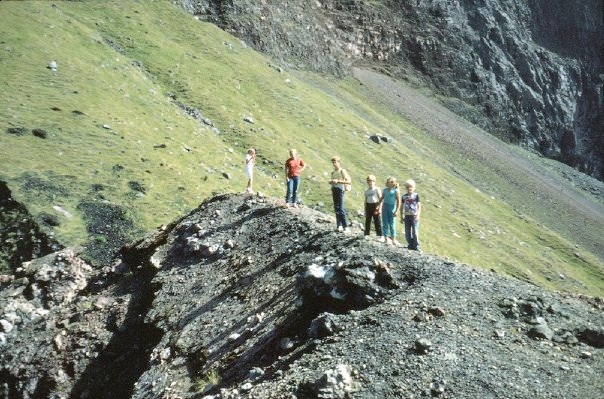
047 Family and island youngsters on the summit of the new volcano.
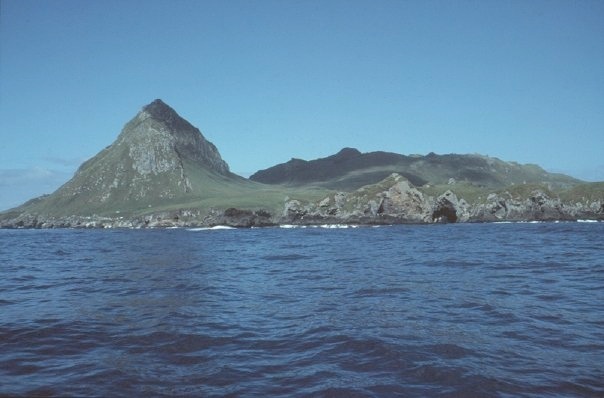
048 Approaching Nightingale Island from the north-west.
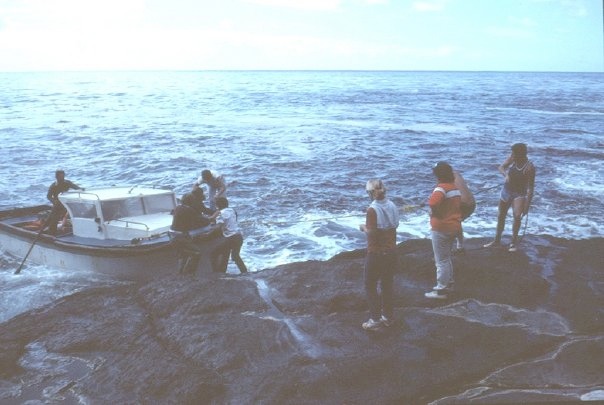
049 Landing on Nightingale — no beaches anywhere in the group.
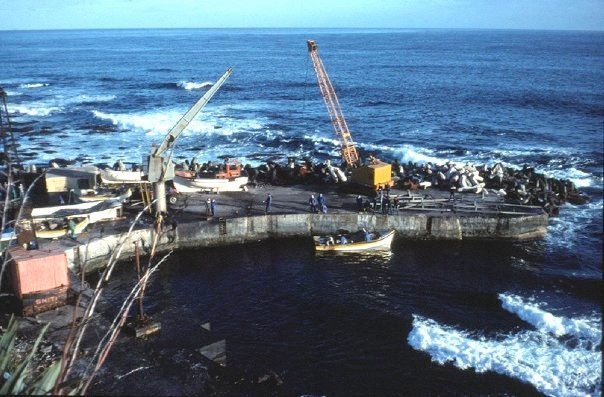
050 Boatharbour from the access road up to the crayfish plant.
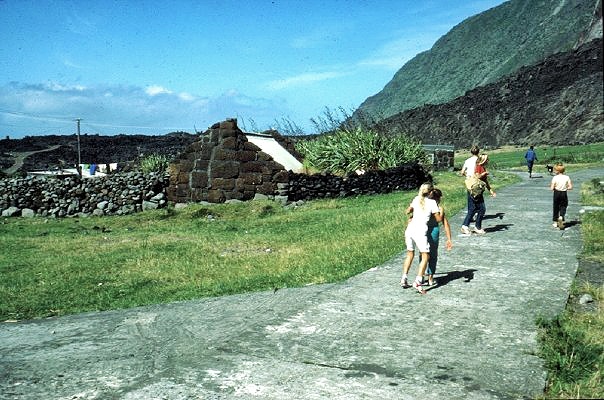
051 One of the village 'roads' with the 1961 volcano behind.
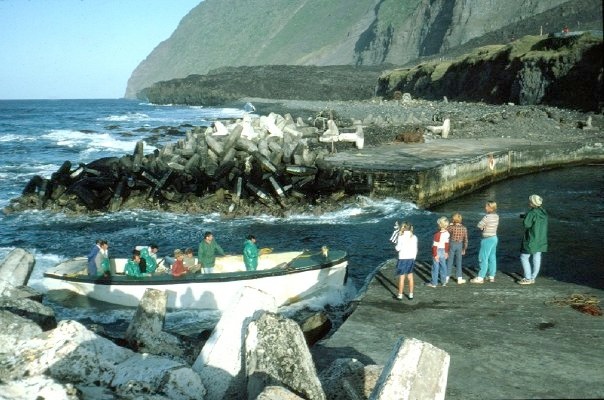
052 A fishing boat returning to Boatharbour after a day's crayfishing.
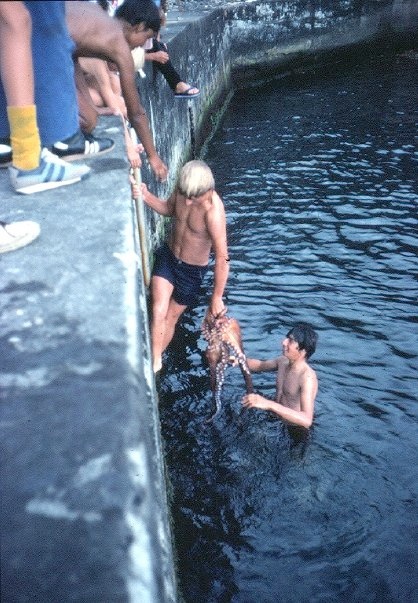
053 Ian and Dan with an octopus caught in Boatharbour.
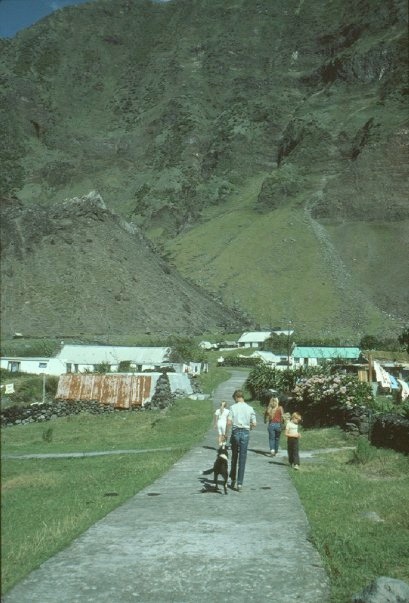
054 The family walking through the village with Tristan above us.
We left three months later on the M.V. Tristania, one of the crayfish processing and storage vessels that service Tristan from Cape Town. We stepped off in Cape Town in May 1987, weary and a bit sad, richer for the trip in a way that has nothing to do with money. A closer family unit than before. Chricanto is on the rocks at Tristan still, somewhere.
That a mast can come down in the middle of an ocean and you can put a smaller one up. That a thirteen-year-old can stand a watch. That my father was unwavering when the end could so easily have been a tragic one. That my mother has an inner strength second to none. That the most dangerous part of the night isn't the squall — it's the moment afterward, when nothing is making any sound and you can't yet see what's broken.
My father wrote it all down in a book years later, much better than I just have, and I helped him put it together. The full version is his to tell. This is just the part that stayed with me.
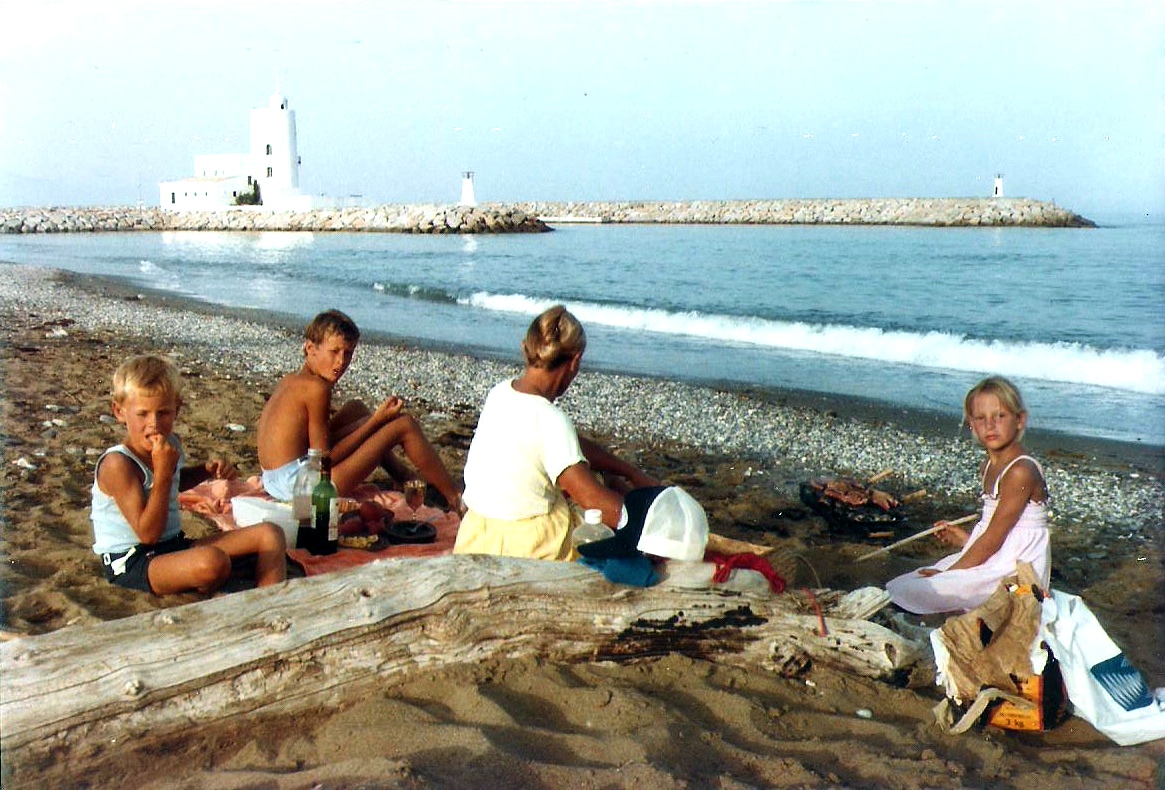
055 Tristan.
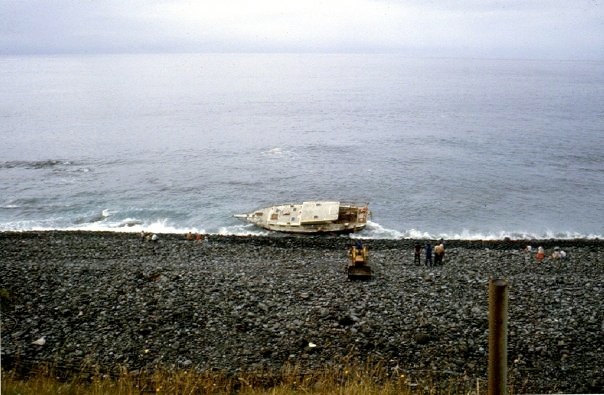
057 Tristan.
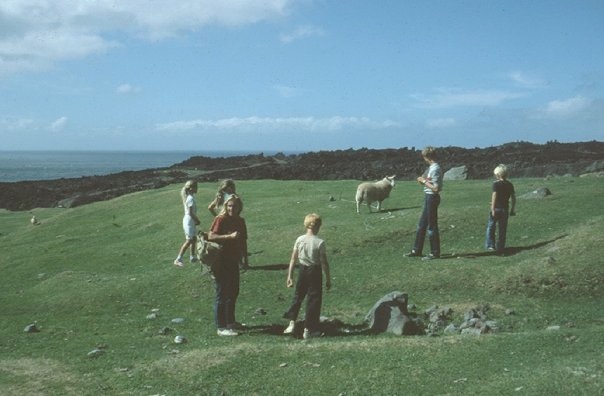
059 Tristan.
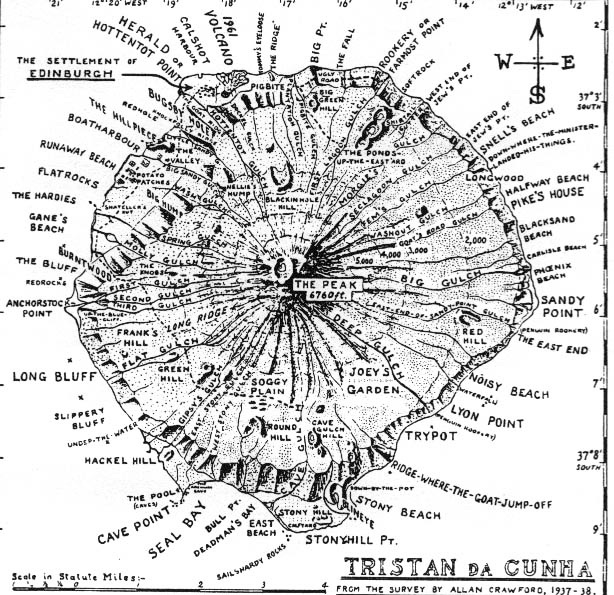
062 Heading home.
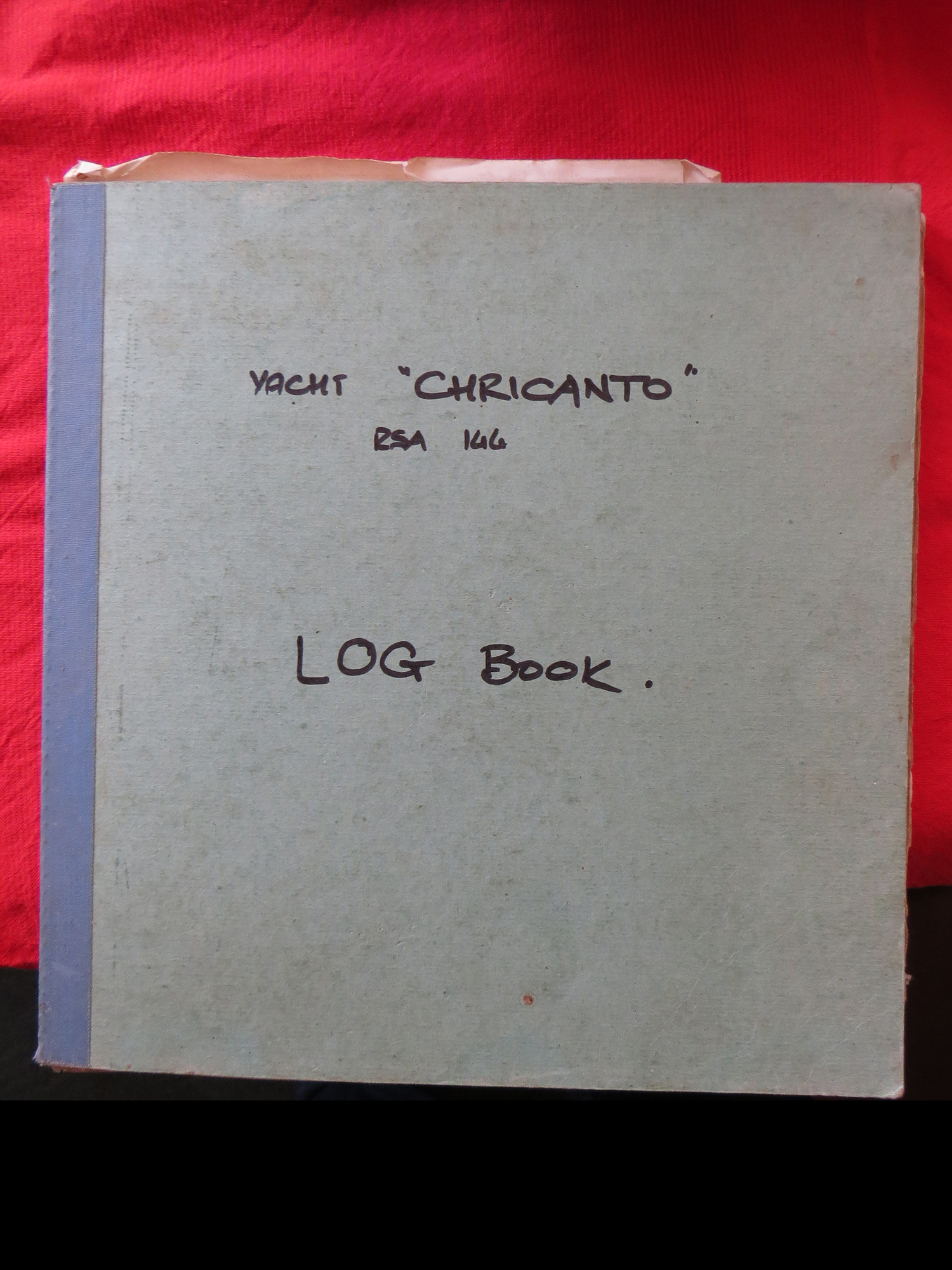
063 Heading home.
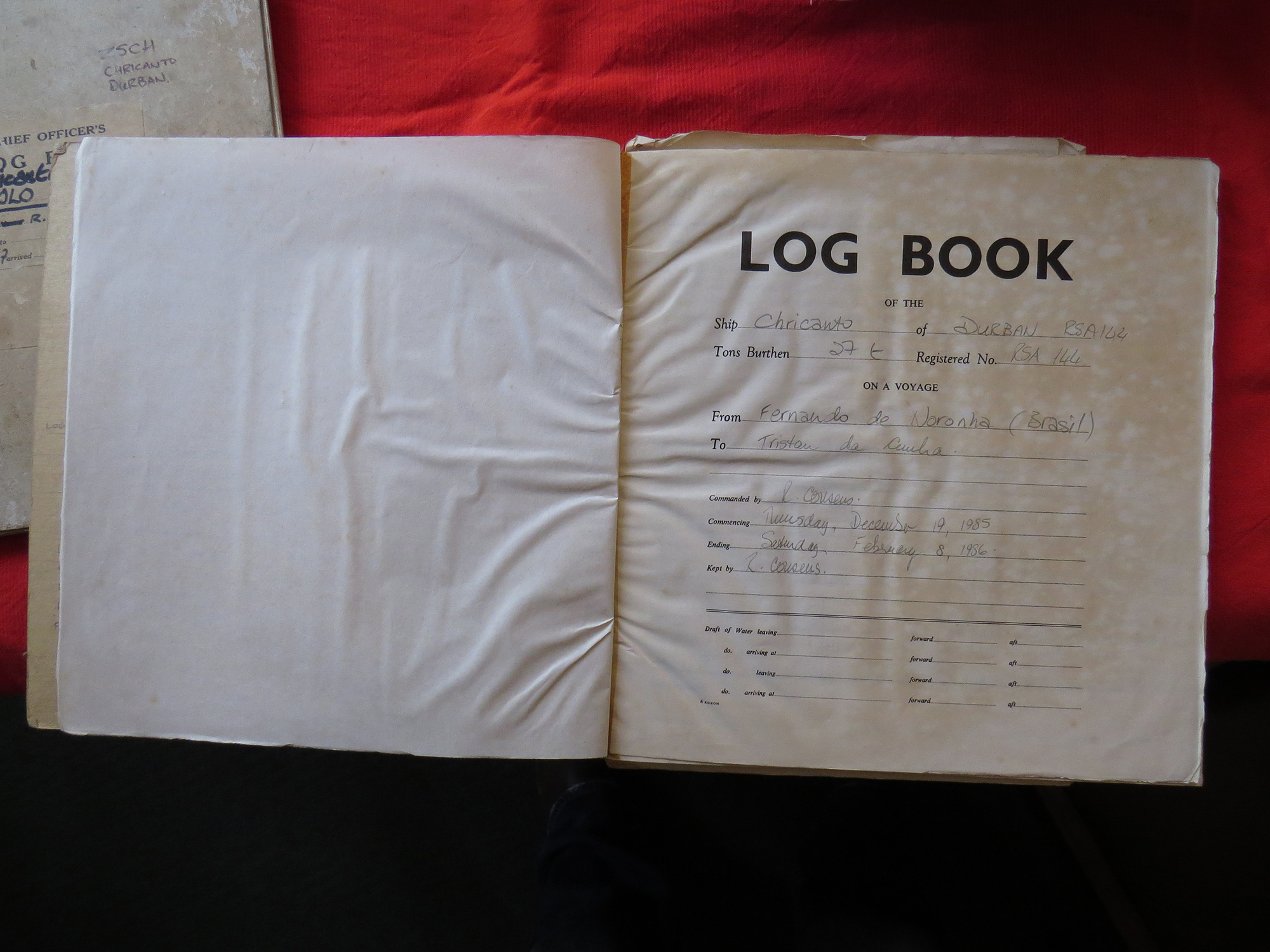
064 The ship's log book. Voyage from Fernando de Noronha to Tristan da Cunha. Kept by R. Cousens.