South
Atlantic
A small family of mammals, in a yacht the size of a long bus, crossing an ocean the size of a continent.
Here, in October 1986, in the warm and blustery air of a port city at the mouth of the Mediterranean, my father walked into a chart office and bought a piece of paper. The piece of paper was a navigational chart of the South Atlantic — a stretch of ocean that, for most of human history, was simply too vast for any practical purpose. He bought it on a whim. He had no intention of visiting any of the islands it described. It was, as it turned out, the chart he would need.
The vessel that would carry us was called Chricanto. She was fifteen metres long and twenty-seven tonnes, made of ferrocement — a curious material that combines steel mesh and concrete — which my father had used to build her himself, by hand, in the front garden of our home in Durban. By the autumn of 1986 the family had been living aboard her for some six years. There were five of us: my father, my mother Margaret, me — then thirteen — my sister Candice, nine, my brother Antony, seven. And one small mammal of our own species, our cat Pusskins.
To understand what was to follow, you must understand the scale of the ocean we were about to cross. The South Atlantic is some forty million square kilometres of saltwater. Its average depth is just over three thousand metres. Across this enormous and largely uninhabited space we proposed to travel in a vessel the size of a long bus, propelled by the wind.
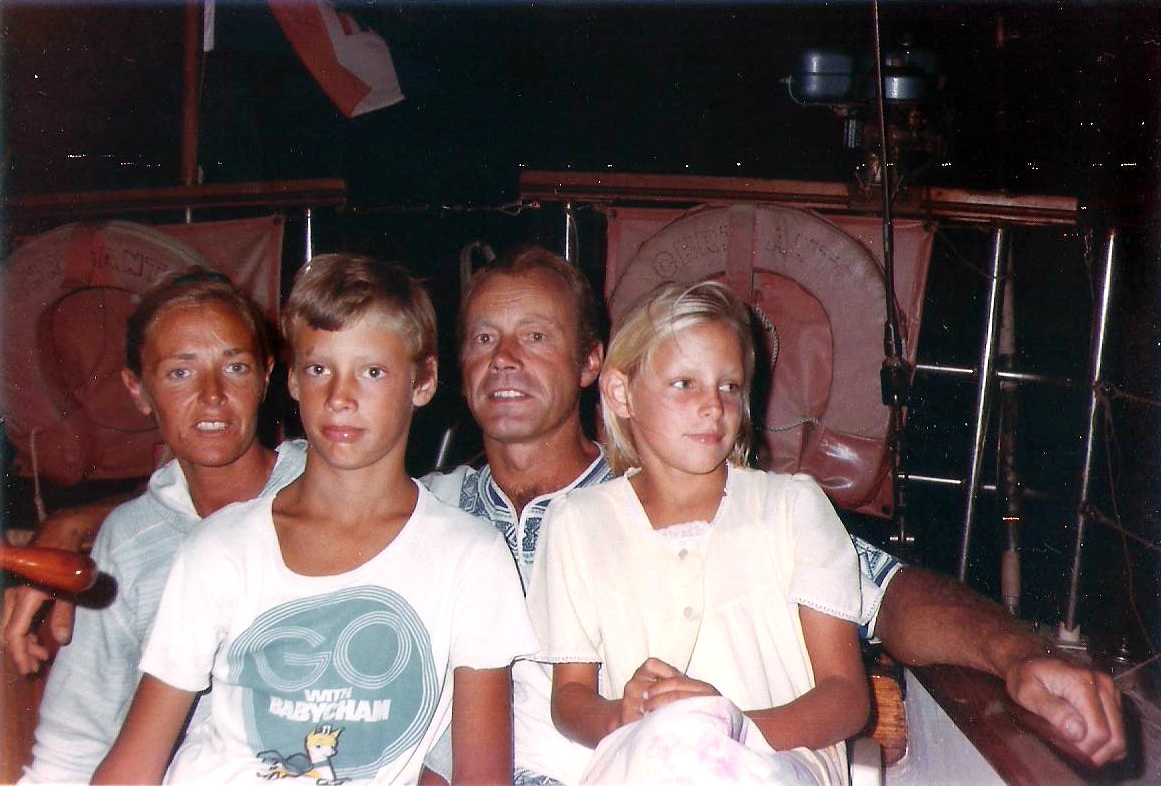
Margaret, me, my father, Candice — aboard Chricanto in the evening.
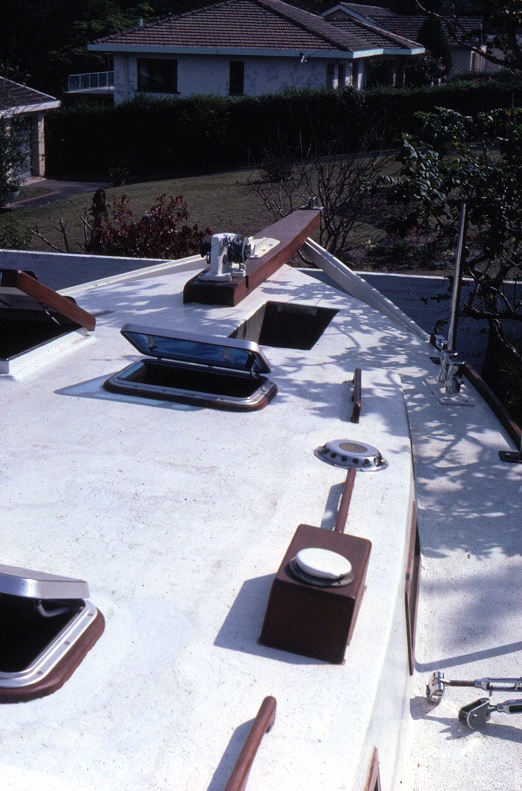
Chricanto, under construction in the front garden in Durban, where she was built by hand over a number of years.
By 1986 Chricanto had counted three places home: Plymouth, in the south of England, where the family had begun life aboard her; Vilamoura, on the Portuguese Algarve, from which we worked the Iberian coast and sailed up the Guadalquivir river to Seville and onward round the corner of Spain; and finally Gibraltar, that small British outpost on a limestone rock at the southern tip of Europe, from which we had recently returned from a cruise to the Balearic Islands.
On the twentieth of October we sailed into thick fog. The fog cleared as the easterly wind known locally as the Levanter — funnelled through the gap between Spain and Morocco, sometimes with ferocious results, that day a gentle push — blew us cleanly out of the Straits. Within hours we had passed beyond the influence of the continental coast and into the open ocean. The wind generator above the cockpit began to turn quietly in the breeze. The autopilot was engaged. The twin headsails were poled out wing-and-wing. There is something profoundly calming about the moment a small vessel finally enters the deep ocean. The horizon becomes a perfect, unbroken circle.
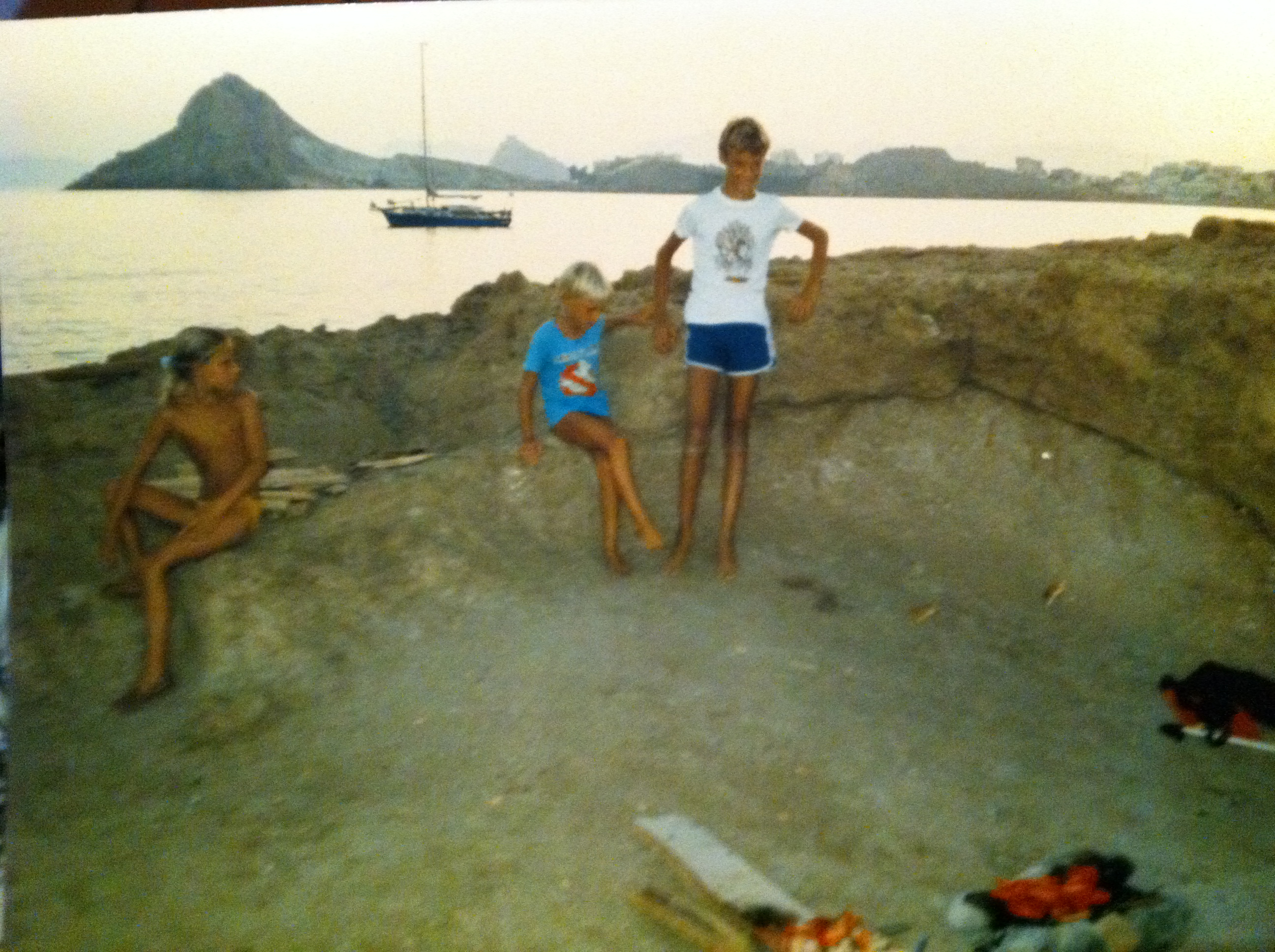
The three of us on the Spanish coast at dusk. Chricanto at anchor behind. The Mediterranean light, just before the journey south.
It was on the following night, a day clear of the Straits, that my father asked me to stand my first solo watch. I was thirteen. He briefed me carefully on what to watch for, and went below to sleep in my parents' bunk. He did not look in on me again until I called him.
Some hours into the pitch dark I began to hear sounds coming up through the hull. They were not, strictly speaking, the sounds of marine life — though they resembled the high-pitched echolocation clicks of dolphins, the cadence was not quite right. They were the sonar pulses of submarines, or some kind of naval acoustic equipment. Around us, all but invisible in the moonless dark, were a number of warships running blacked-out. We had sailed into the middle of a naval exercise. A helicopter passed low overhead, banked, and returned the way it had come. My mother called on channel sixteen and received no response. My father came up. We watched, in silence, as the dark shapes of the warships moved past us and disappeared east. No one ever acknowledged our presence.
Seven days later we made landfall at Porto Santo in the Madeira archipelago. There, by an extraordinary coincidence, we found ourselves anchored next to a yacht belonging to an old family friend — Patrick Green, of Fowey in Cornwall — whom we had not seen for four years. Neither of us had known the other was sailing this way. A few days later, in the harbour at Funchal on the main island, we encountered a second old friend from Durban: Ed Davies, aboard his yacht Flagon. In an immensely vast world, sometimes it shrinks.
All of us — the family and Patrick — climbed Madeira to the Pousada at Pico Ruivo, the highest peak on the island. It was November, and the air at six thousand feet was thin and cold. My brother Antony was seven, and possessed of the remarkable internal thermoregulation that human children of his age sometimes have — his body temperature ran a degree or two warmer than the rest of us. The family put this to use that night, placing him in each of our beds in turn until the sheets warmed. He approved of the arrangement; it cooled him down. The following morning we walked down the mountain in plastic bin liners, the rain being heavier than expected and our wet-weather gear being absent.
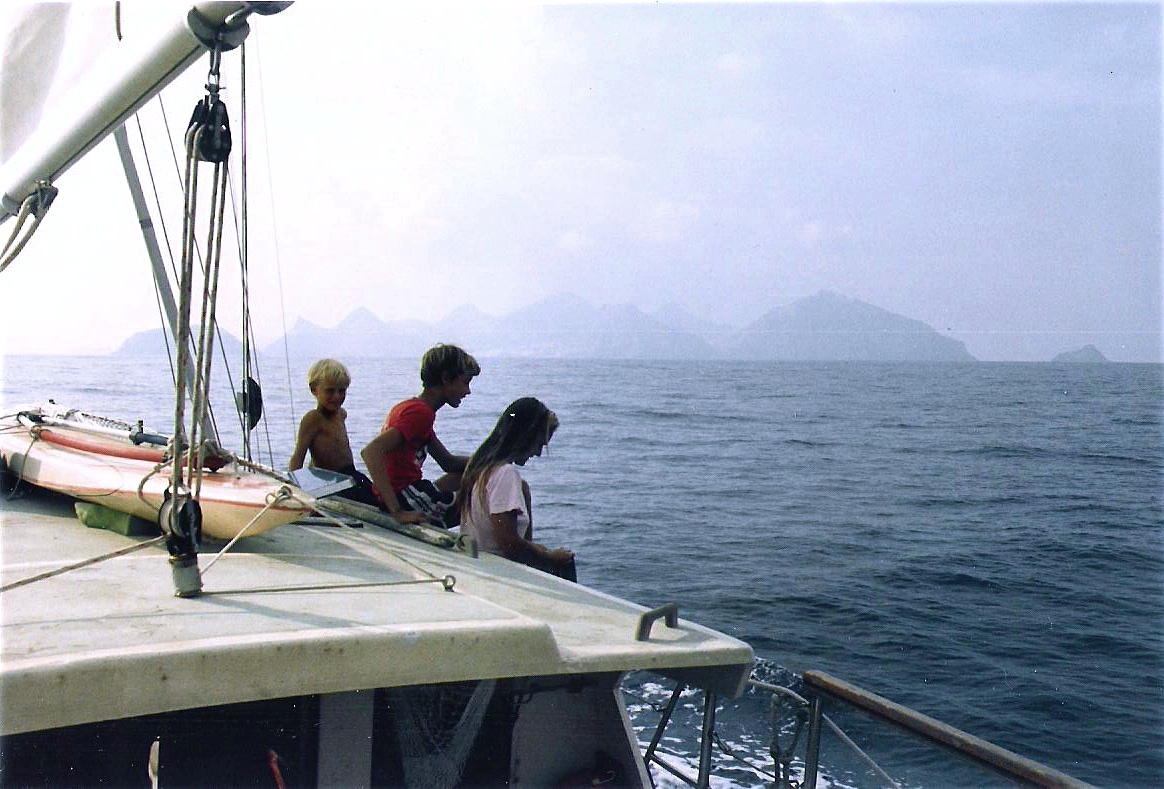
Approaching the eastern tip of Porto Santo, one of the four islands in the Madeira group.
From Madeira we sailed south to the Canary Islands. The intended landfall was La Palma, but four hours out we encountered a south-westerly gale and diverted to Tenerife. From there we worked down the coast to the small harbour at Los Gigantes, set beneath cliffs of considerable size, with surf breaking right across the entrance — a feature that required precise timing of the wave sets in order to enter safely. From Tenerife we sailed on to La Gomera, the only island in the archipelago without an airport, and consequently the least visited. Leaving her, the north-east trade winds picked up. Seven boisterous days under twin running headsails took us to Ilha do Sal in the Cape Verde Islands — four hundred miles off the coast of West Africa.
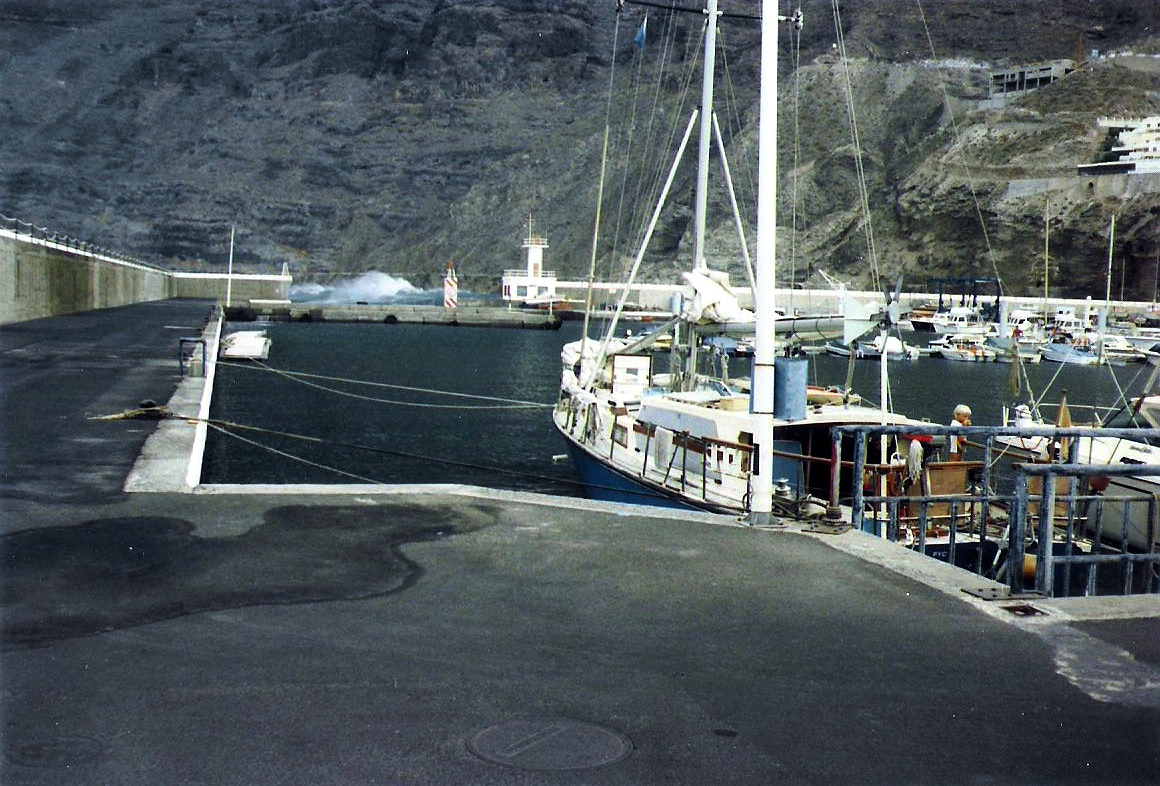
Chricanto safely alongside in Los Gigantes, beneath cliffs that rise some six hundred metres directly from the sea.
Ilha do Sal — Salt Island — was in 1986 the staging post for South African aircraft routed around the bulge of West Africa. The island is a desert. It has almost no rain. Its inhabitants are among the most generous people in the South Atlantic.
Every passing vehicle on Sal stopped for hitchhikers. Not slowed. Stopped. While we waited for new sail slides to arrive — the original ones, hardened by six years of sun and salt, having begun to break at all hours of the night — the technicians stationed there drove us round the island, showed us the salt mine in the cone of an extinct volcano that gives the island its name, and kindly fed us lobster.
It was on Sal that I stubbed my toe in the water and contracted blood poisoning. The infection moved up my leg in dark veins, like a tideline you could watch advancing. The foot itself went dark. I ran a high fever. There was no hospital on the island. My mother — who, as you will come to understand, has an inner strength second to none — started me on antibiotics and sat with me. The tideline stopped advancing. The fever broke. The colour came back.
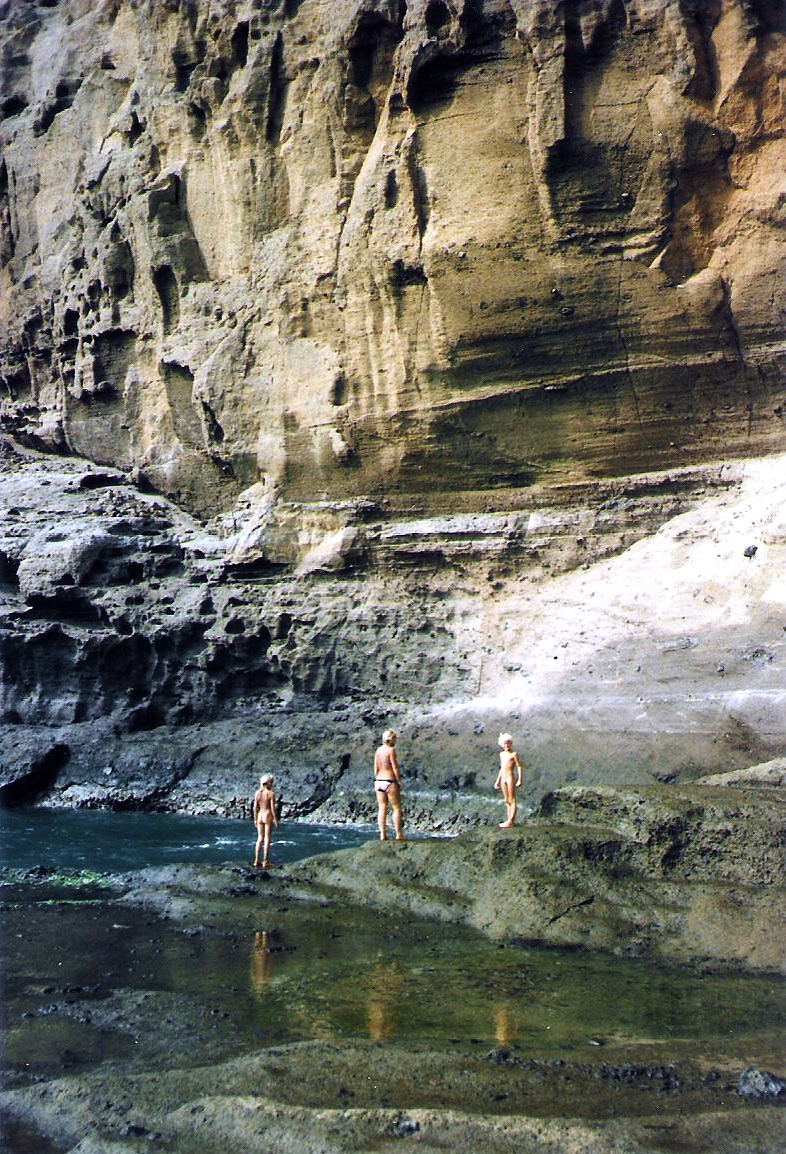
The volcanic cliffs of Ilha do Sal, formed some thirty million years ago when the African plate moved over a hotspot in the Earth's mantle.
From Cape Verde we set out on the long ocean crossing to South America. By the morning of the second day, fine dunes of red Saharan sand had blown across to settle on our deck. The wind that brought them had come from over a thousand miles of empty desert.
We crossed the doldrums — the band of low pressure around the equator where the trade winds of the two hemispheres meet and cancel — without resorting to the engine. When the wind died altogether, which it sometimes did for days at a time, the family would jump off the side of the boat and swim alongside her, with one of us always keeping a lookout from the cockpit. The water beneath us was, at one point, over three thousand metres deep.
On one afternoon my mother announced calmly, from the deck, that we should consider returning to the boat. As we climbed back aboard she pointed out two large fins, twenty metres away, drifting past with the unhurried manner of large pelagic predators. They were almost certainly oceanic whitetip sharks — the species responsible for most open-ocean attacks on humans. We refrained from swimming for some days afterwards.
Eighteen days from Cape Verde, twenty Atlantic spotted dolphins shepherded us into the anchorage at Fernando de Noronha — a small Brazilian island formed from the upper reaches of a submerged volcanic mountain that rises four thousand metres from the abyssal plain below.
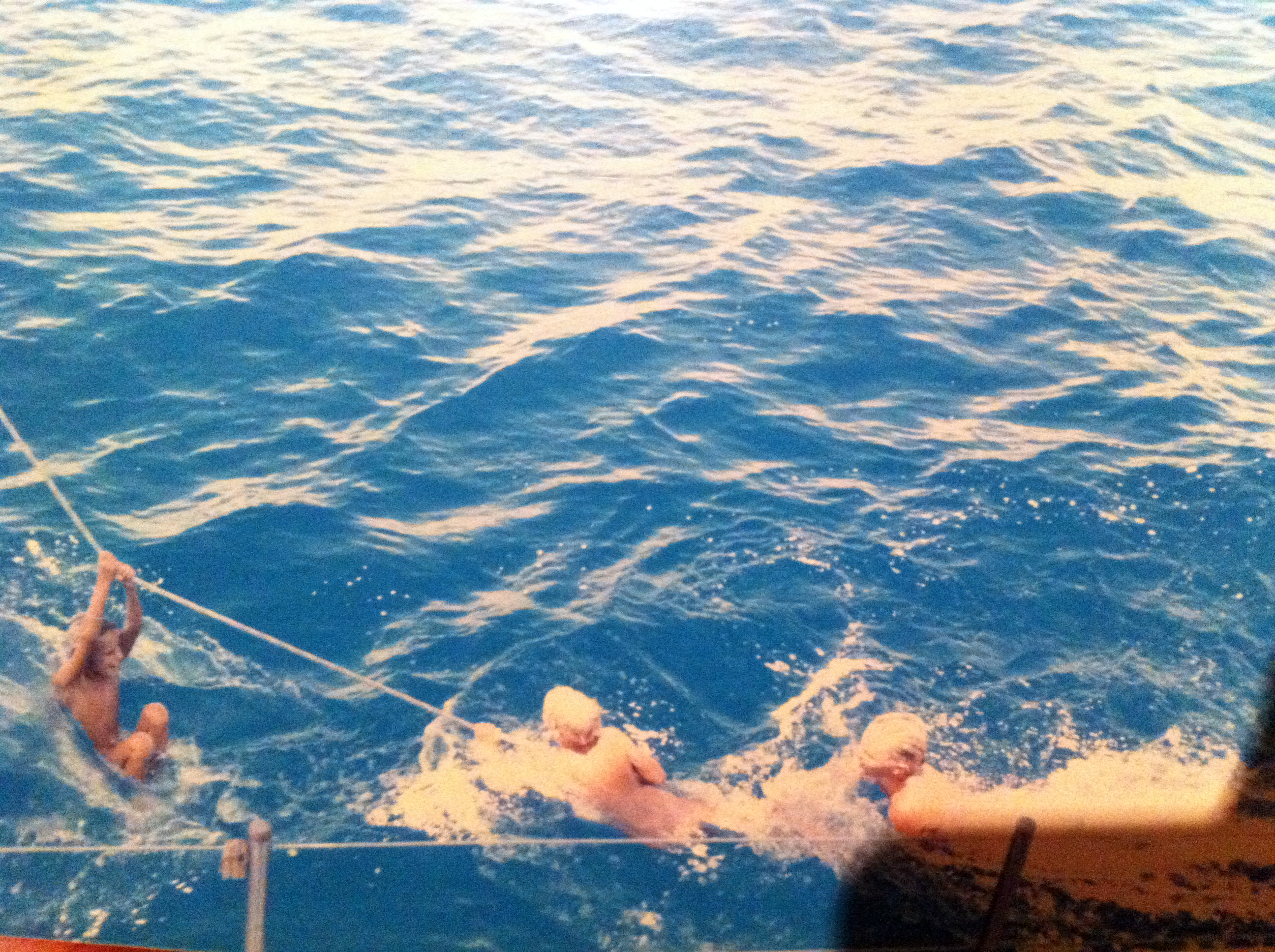
Cooling off on a day of light airs. Beneath us, two thousand metres of clear blue water.
Fernando de Noronha is, today, a protected marine reserve. In 1986 it was a Brazilian military prison-island. The Brazilian Navy deep-sea tug Almirante Guilhem, which had arrived during the night to deliver supplies, became — through the simple kindness of her captain and crew — one of the warmest memories of the voyage. They invited the children of Chricanto aboard for dinner. They gave us their entire ration of ice cream. Their football team won a televised match while we were on board, and they fired green flares from the deck to celebrate.
From Fernando we sailed to Recife on the Brazilian mainland, where we celebrated Christmas. Brazilian inflation, at that time, was running at over a thousand percent a year. The exchange rate while we were at Fernando had been ten thousand cruzeiros to the US dollar. A week later in Recife it had become fourteen thousand. We cashed one hundred dollars at the Café San Francisco and walked out with one and a half million cruzeiros — an experience which, briefly, made one feel very rich indeed.
On the thirtieth of December we sailed once more for South Africa. The distance ahead of us was three thousand three hundred and seven nautical miles.
For the first two weeks the wind was sparse. We drifted south rather than sailed, our day's runs sometimes as little as thirty-five miles. The ocean here is among the emptiest of all sea-states on Earth — for periods of weeks, the closest ship to us was probably several hundred miles away.
On the morning of the seventeenth of January 1987, at 29° 53′ S, 24° 12′ W — twelve hundred nautical miles from the coast of South America, and seven hundred and forty from the nearest landfall — a line squall came out of the southeast at half past one in the morning.
It is a quality of line squalls that they are short, sharp, and concentrated. This one was severe. The sails caught aback. The boat went over. The mast — sixty-one feet of aluminium, the central spine of the vessel — came down across the port side, taking with it the navigation lights, the radio antenna, and most of the rigging. The wind died as suddenly as it had come, leaving an eerie silence and the broken mast thumping against the hull.
My mother, who had not been thrown out of her bunk in six years of living aboard Chricanto, was thrown out of her bunk.
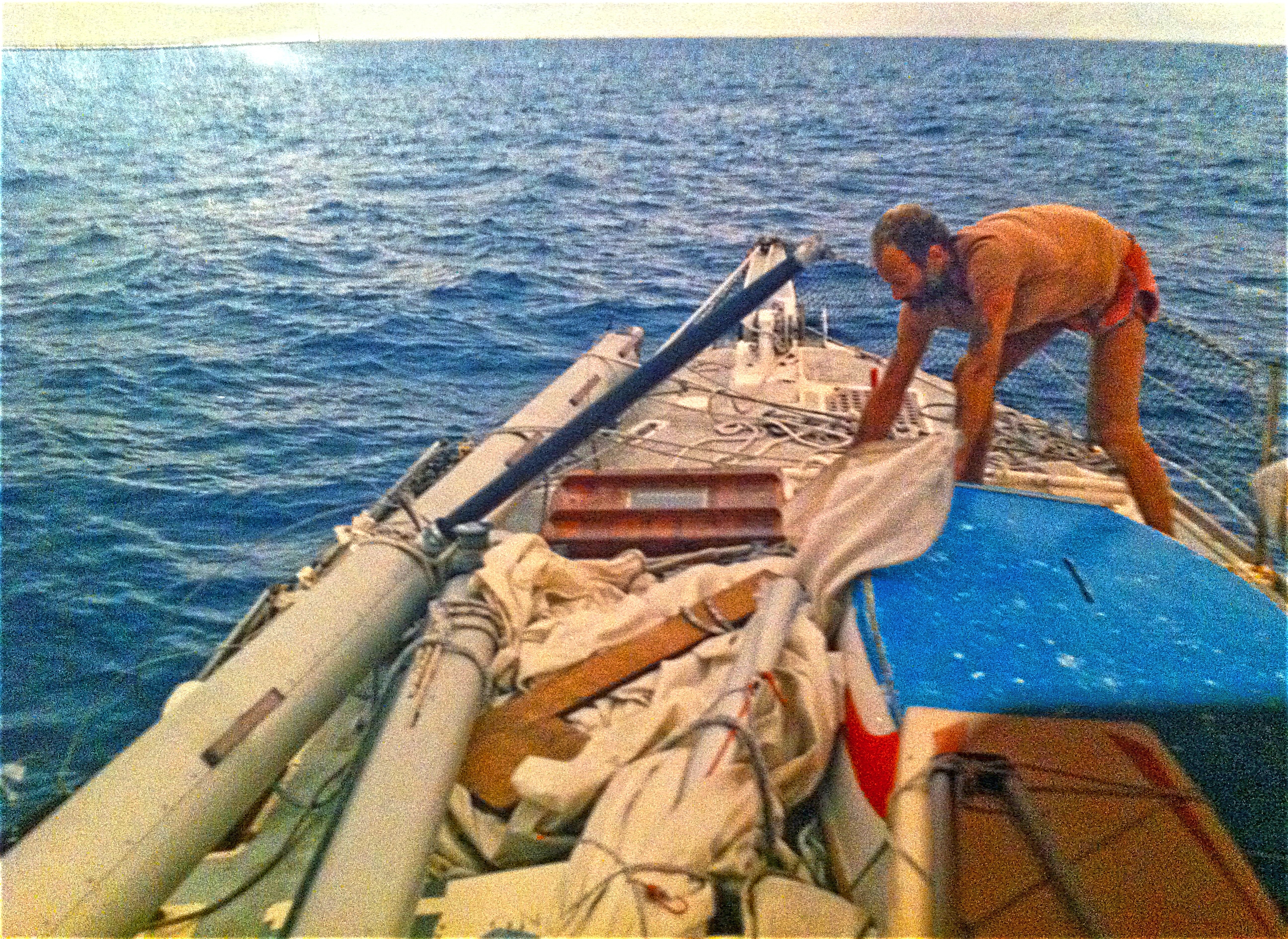
The morning after the dismasting. My father working through the wreckage of the rig.
Tristan da Cunha lies at thirty-seven degrees south, twelve degrees west, in the middle of the South Atlantic. It is the most remote inhabited island on Earth. Its nearest neighbour — St Helena — is fifteen hundred miles away. Approximately three hundred and fifty people live there.
From the position of our dismasting, Tristan was seven hundred and forty nautical miles to the south-east. We had food for some weeks, water for many more, and fuel for two hundred miles — nowhere near enough to reach safety under power. My father drew a circle on Chart 1769, the chart he had purchased on a whim in Gibraltar, and decided to head for it.
A white-tipped shark joined us at first light. He kept station a few metres behind the boat for the next two weeks.
Over the days that followed, the family constructed a jury rig from the salvaged remains of the mast and the modified sails: a trysail set as a main, two cut-down jibs poled out forward, a storm jib hanked upside-down on a backstay. The first day under jury rig we made sixty-seven miles. After that, the rig being utterly useless to windward, our daily progress collapsed to five or ten miles toward Tristan.
Once, a dorado — a beautiful blue and green fish abundant in those waters — swallowed a piece of hacksaw blade that my father had thrown overboard. We caught the dorado later. The blade was inside it. My father threw the retrieved blade back into the sea, and another dorado promptly swallowed it. He did not throw anything else overboard.
Seventeen days after the dismasting, a fishing vessel passed within sight. My father fired eight parachute flares, four hand-held flares, and a smoke float. My mother called on channel sixteen. The vessel — an Asian fishing boat, white-hulled, apparently devoid of life — steamed on by and disappeared over the horizon.
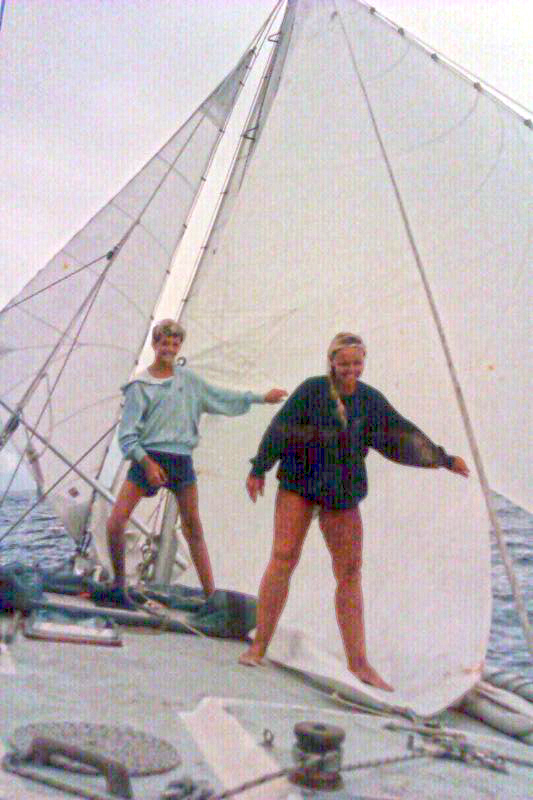
My mother and me with the jury rig hoisted — a trysail for a main, two cut-down jibs forward, a storm jib upside-down on a backstay.
On the morning of the seventh of February I awoke to find that my hake — a small fish, hand-sized, that had been swimming behind the boat for weeks, nibbling weed off the transom, and that the family had been saving to eat at landfall — was missing. The rest of the family had cooked and eaten him for breakfast while I slept. I have not, even after the intervening decades, entirely forgiven them.
That same afternoon, at fifteen-fifteen, the mist cleared and the symmetrical volcanic cone of Tristan da Cunha — six and a half thousand feet high, rising abruptly from the deep ocean floor — appeared dead ahead, fifty-five miles off, with cloud wreathing the peak.
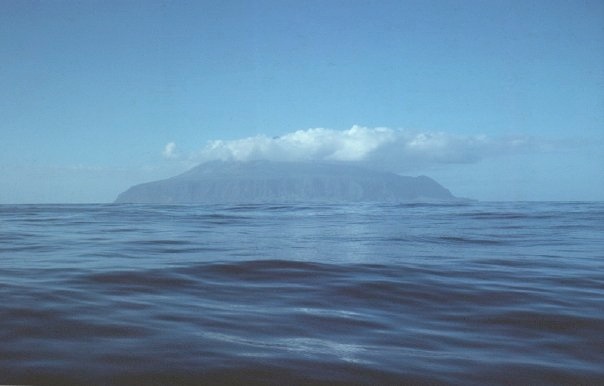
Tristan da Cunha bearing 075, distance 8 nautical miles. Cloud across the peak.
The wind that night veered to the north and built to Force 5, gusting 6 — conditions unsuitable for an approach to a lee shore in the dark. We spent the night beating to and fro five miles off a pitch-black island. At first light we edged in toward Edinburgh-of-the-Seven-Seas, the only settlement.
The islanders sent out their launch through rough seas to meet us. After forty days at sea, we spoke to people who were not each other.
We had made a pact that as soon as we stepped onto dry land we would open the bottles of Brazilian Guarana we had been saving for the purpose — bottles which, by an unfortunate visual resemblance, looked exactly like beer. We drank them on the quay at seven in the morning. The islanders gave us some very strange looks.
The ground did not stop heaving for days.
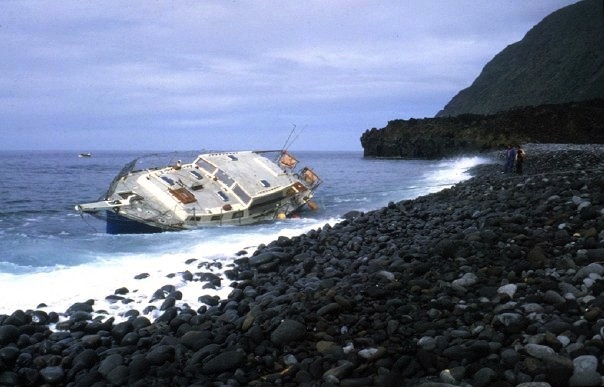
Chricanto, beached on the rocks east of Boatharbour. The island government bought most of what could be salvaged. The hull was left to break up.
After much consideration my father decided not to attempt the remaining fifteen hundred miles to Cape Town in a leaking, jury-rigged yacht. The Roaring Forties — that band of strong westerly winds in the southern hemisphere — lay directly between Tristan and Cape Town. On the Sunday after our arrival, in a flat calm sea, we stripped Chricanto of everything of value. The island government bought most of it. They beached her on the rocks for the prop and shaft. By the time we left three months later, she had begun to break up.
Tristan in 1987 had a population of approximately three hundred and fifty. They share seven surnames between them. Until the war they were paid in potatoes. The island has no airstrip, no harbour large enough for a deep-water vessel, and no road of any length. The only way on or off the island, in those days, was by sea. The volcanic peak of Queen Mary's Peak — the same peak my father had used as his point of approach — last erupted in 1961, requiring the temporary evacuation of the entire population to England.
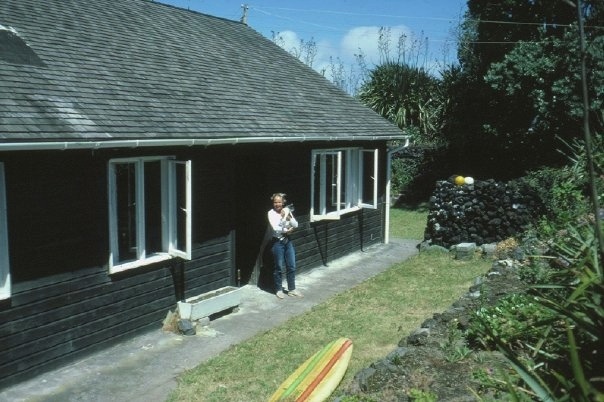
The bungalow allocated to us. Used by scientific expeditions from time to time.
We lived in a wooden bungalow above Boatharbour. Our cat Pusskins was, at that time, the only domestic cat on Tristan. The island children had never seen one. We held school excursions to our bungalow so they could touch her. The island cattle, who had no frame of reference for the animal, found her sufficiently alarming that one cow ran away. I attended St Mary's school. On the twenty-second of April we helped tow the longboats — light canvas-over-timber craft, unique to the island — out to sea, as a third of the population set off on their annual fatting trip to render shearwater chicks for cooking oil. They were due back in five days. The weather kept them on Nightingale for a month. They returned in good health.
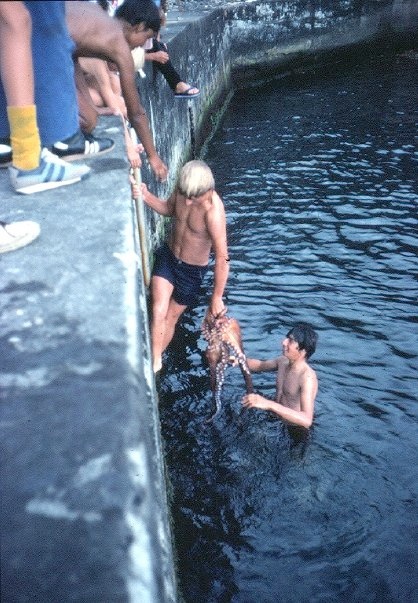
Ian and Dan, two of my Tristan friends, with an octopus caught in Boatharbour.
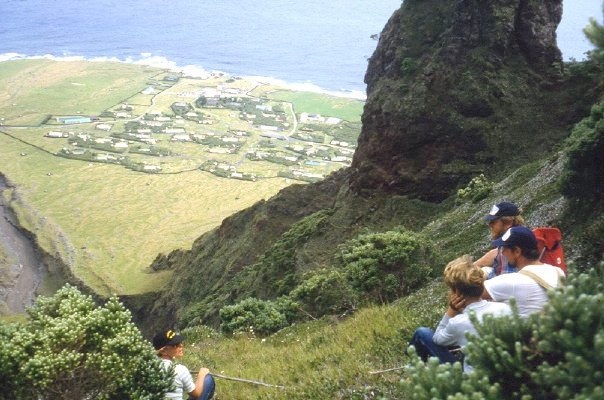
The settlement from the upper escarpment above Hottentot Gulch, on our way up.
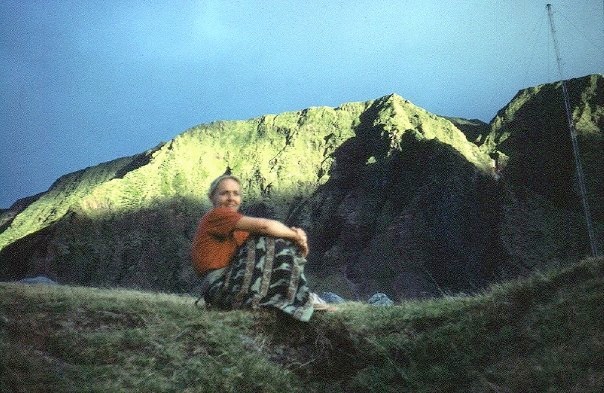
My mother on the slope below the Ponds, with the volcanic ridge of Pigbite rising behind her in the evening light.
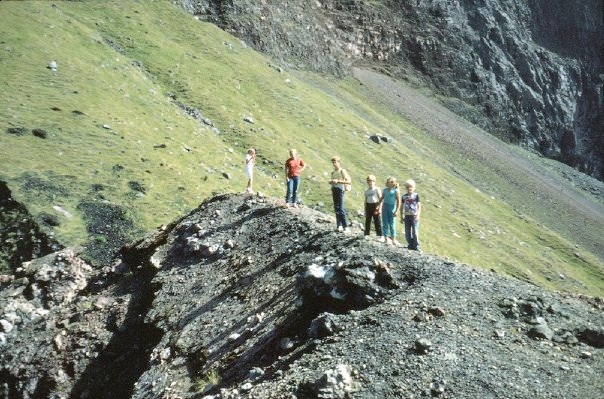
Family and some of the island youngsters on the summit of the new volcano.
In May 1987 we sailed for Cape Town aboard the M.V. Tristania, a small refrigerated vessel that services the island from South Africa. We stepped off in Cape Town weary, a little sad, and richer in the way that has nothing to do with money. Chricanto remained on the rocks at Tristan, breaking up gradually under the weather, becoming over time a few aluminium and timber remnants on a remote shoreline, of interest only to the seabirds.
There are, in a journey of this kind, lessons that one only fully understands later.
That a mast can come down in the middle of an ocean, and you can put a smaller one up. That a thirteen-year-old can stand a watch. That my father was unwavering when the end could so easily have been a tragic one. That my mother has an inner strength second to none. That the most dangerous part of the night is not the squall — it is the moment afterwards, in the silence, before you can yet see what is broken.
My father wrote it all down years later, in a book, and I helped him put it together. The full account is his to tell. What you have read here is what stayed with me.